Disney Era Analysis – Meet the Robinsons
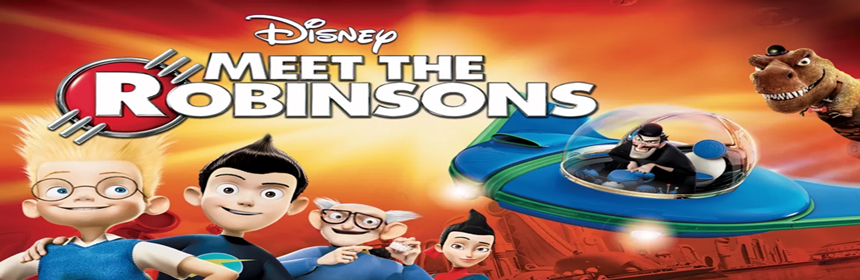
As mentioned in the first blog post in this series, I’ll be writing analysis content on all 60+ Disney animated feature films and their film making eras.
The sixth era is the Post-Renaissance Era, which ran from 1999 to 2008 and started with Fantasia 2000. As mentioned in a previous blog post, the Post-Renaissance Era is known for: its experimentation with both computer-generated (CG) animation (and alternating between traditional hand-drawn and CG animation), and its experimentation with storytelling.
The Post-Renaissance Era is also referred to as Disney’s Second Dark/Bronze Age and Experimental Era.
So how well did Meet the Robinsons measure up to these famous features?
Experimentation with computer-generated (CG) animation (and alternating between traditional hand-drawn and CG animation):
This film is CG animated. According to the film’s Wikipedia page, the main challenge for the animators was creating and animating CG humans (as opposed to the previous film, in which the challenge was creating and animating CG animals). The design of the film was inspired by 1940s architectural design and Technicolor films. In terms of animating the characters, the crew took inspiration from The Incredibles and Disney animated feature film classics, Alice in Wonderland, Cinderella, and Peter Pan, as well as Warner Bros. Cartoons from the 1950s.
A few small animation inclusions that I loved was the inclusion of a real photo of Tom Selleck describing what Wilbur’s father looked like, especially with the reveal that Tom Selleck would voice Wilbur’s father towards the end of the film, as well as the sepia tone of the past when Lewis’ mother leaves him at the Orphanage’s doorstep.
Experimentation with storytelling:
This film is based on the book, A Day with Wilbur Robinson, by William Joyce. According to the film’s Wikipedia page, the film’s director, Stephen Anderson, decided to direct the film, due to his connection to Lewis, as they both grew up adopted. This film is classified as a science fiction comedy.
Due to the film’s time travelling nature and twist, there were many Easter eggs throughout the film, including but not limited to: the footsteps heard at the beginning of the film and the reveal of whose they were at the end, the small detail of the drawn smiley face on the back of Bud’s head which leads to the reveal of who he is at the end of the film, and Wilbur helping Franny with her frogs without hesitation during the science fair.
My overall thoughts:
I had heard that this was a good film and after watching it, it was easy to see why. It would be easy to get caught up in the CG, 3D animation, and fantastical landscape and architecture design, and maybe even write it off as another attempt by Disney to make another successful science fiction experiment, however what stops it from being a write off is its deep, meaningful, and hopeful messages.
I appreciated that whilst Goob was an eccentric, over-the-top villain initially, he didn’t lose his humanity and even became sympathetic once he realised that Doris manipulated him. I also appreciated how strong the writing was with the time travel elements, it’s easy for a story to get out of control and develop noticeable plot holes within that genre (and I’m sure there are some that I probably missed), however I personally felt that the writing was tight and the inevitable Easter Eggs that come with time travel writing were fun to discover.
I appreciate the good quality of this film’s animation and story after the misfires that were its two most recent predecessors.
The next part of the Disney Era Analysis series will focus on Bolt.
Fun Facts and Trivia (according to the film’s IMDb page):
- A picture of Walt Disney and Nikola Tesla is seen in the orphanage.
- The science fair that Wilbur attends is held at Joyce Williams Elementary School. This is a nod to the author of the original story, William Joyce.
- The “Todayland” park pays homage to the original “Tomorrowland”, the futuristic area of the Disney theme parks. Immediately noticeable are Space Mountain and the original Rocket Jets.
- At the science fair, Professor Lucille Krunklehorn describes her invention, the Caffeine Patch, which contains 12 cups of coffee. She displays 16 patches on her right arm, totalling 192 cups or 12 gallons of coffee.
- The squiggly lines on the central monitor in Lewis’ design drawings of the Brain Scanner spell out the word ‘mom’.
- In the 3D version of the film, the final credits are all in 2D, except for the names of the people who converted it to 3D.
- The plaque on the 6th Street Orphanage at the start of the film states: “Established in 1855, the orphanage moved to its current site in 1892. It was founded by the nuns of the 6th Street Parish during the 1852 cholera outbreak, which left many young people homeless. The Orphanage has operated continuously since its founding.”
- Doris’ name originates from DOR-15, the number of the chamber she is assigned to in the rejected inventions room at Robinson Industries.
- If Lewis is 12 in 2007 and 42 in 2037, that means he was born in 1995. If his future son, Wilbur, is 13 in 2037, that means Wilbur was born in 2024.
- When Wilbur reveals his family, he mentions his father looks like Tom Selleck. Tom Selleck actually provides the voice for Wilbur’s father.
References:

