Disney Era Analysis – The Princess and the Frog
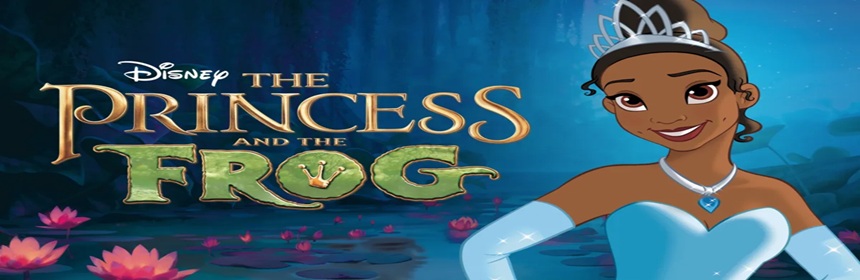
As mentioned in the first blog post in this series, I’ll be writing analysis content on all 60+ Disney animated feature films and their film making eras.
The seventh era is the Revival Era, which ran from 2009 to 2019 and started with The Princess and the Frog. As mentioned in a previous blog post, the Revival Era is known for: its return to the “old formula” (storytelling similar to the Renaissance Era), improved and advanced computer-generated (CG) animation, evolution in its storytelling by adapting stories from sources other than old books, and well thought-out stories paired with improved animation.
So how well did The Princess and the Frog measure up to these famous features, and was it the right film to kick off the Era?
Return to the “old formula” (storytelling similar to the Renaissance Era):
This film returned to the “old formula” in the following ways:
- It was the first Disney animated musical feature film in which all of the voice actors do both speaking and singing parts since Beauty and the Beast. The film was also a return to the Broadway-musical style seen in the Renaissance Era films.
- The animation style was influenced primarily by Lady and the Tramp for the city scenes, and Bambi for the bayou scenes. According to the film’s directors, these two past films were the “peak of animation in the classic Disney animation style.”
- There are several visual nods to other Disney animated feature films from the past, including but not limited to: Sleeping Beauty, Snow White and the Seven Dwarfs, The Aristocats, The Jungle Book, and Fun and Fancy Free. The most obvious visual nod is Naveen and Tiana taking a ride on Louis’ belly as he swims, which is similar to Mowgli taking a ride on Baloo’s belly in The Jungle Book.
- Tiana is an official Disney Princess, the first one of the Revival Era, with her predecessor being Mulan from the Renaissance Era.
Improved and advanced computer-generated (CG) animation:
According to the film’s Wikipedia page, Toom Boom Animation Inc.’s, Harmony, computer software was used as the main software for the film’s production. This was due to the CAP System, that was used in the films in the Renaissance Era, had become outdated in the early 2000s. The Harmony software was augmented with a number of plug-ins to provide effects similar to those that the CAP System provided.
Other computer software that was used for the film’s production included Adobe Photoshop and After Effects. Photoshop was used to emulate the appearance of painted strokes and fills, with After Effects being used to combine character animations with backgrounds. Photoshop was also used to paint the backgrounds. The visual effects and backgrounds for the film were created using Cintiq tablet displays, and the architectural elements were based upon 3D models built in Autodesk Maya.
Evolution in its storytelling by adapting stories from sources other than old books:
According to the film’s Wikipedia page, this film was inspired by The Frog Princess, a 2002 novel by E.D. Baker, and is a modern adaptation of the German folk tale, The Frog Prince, published in the 1812 book, Grimm’s Fairy Tales. So, whilst this film is an adaptation of an old tale, it was inspired by a modern one released not too long before the film’s release.
Well thought-out stories paired with improved animation:
As mentioned above, the film was inspired by The Frog Princess and The Frog Prince, however Disney changed several key elements to the film after receiving numerous complaints of racial insensitivity. These changes included but were not limited to: the film’s title, the main character’s name, and a subplot being dropped.
According to the film’s Wikipedia page, the film’s head of story, Don Hall, described the plot as a fairy tale “twisted enough that it seems new and fresh”, with the setting being a modern city instead of a traditional kingdom, and Mama Odie being a variation on the Fairy Godmother trope. The film’s co-writer, Rob Edwards, said that the film was a “princess film for people who don’t like princess films”. The writers also thought that Tiana’s motivation of owning her own restaurant wasn’t enough and expanded the motivation to be that it was her father’s dream as well.
As well as trying to twist or modernise The Frog Princess and The Frog Prince, the film was also inspired by real-life people, such as restauranteur, Leah Chase, and Tennessee Williams and his plays.
In regards to improved animation being paired with a well thought-out story, the animators incorporated the front teeth, expressions, and gestures of Keith David into the Dr. Facilier character. I also noticed that even though Disney returned to 2D animation with this film, with the improvements in animation software, it looked crisper and smoother, and that the animation design and style changes with each musical number. I also felt that the animation with the fireflies was beautiful but conversely that the animation with the hunters was a little over-the-top with its slapstick.
My overall thoughts:
Overall, I enjoyed the film and Disney’s return to 2D animation. It definitely reminded me of the Renaissance Era films, and I appreciated the twists and modernisation of its source material.
My favourite moments in the film included the comedic moments between Naveen and Tiana, and the cutaway joke of Louis trying to join the riverboat band.
Based on Disney’s choice of story and their approach to telling it, as well as the improved 2D animation with then-new technology, and the nostalgic feeling I got from watching it, I felt it was the best film to kick off the Revival Era.
The next part of the Disney Era Analysis series will focus on Tangled.
Fun Facts and Trivia (according to the film’s IMDb page):
- The star Ray calls “Evangeline” is, in fact, the planet Venus, named for the Roman goddess of love.
- Dr. Facilier is the only character in the film to refer to himself by that name. All the others call him “The Shadow Man”.
- The alligator character in the film is named Louis, in honour of the jazz great, Louis Armstrong.
- Anika Noni Rose (Tiana) requested that Tiana be left-handed, because Rose herself is left-handed.
- The film takes place between 1913 and 1926.
- One of the floats in the Mardi Gras parade features King Triton from The Little Mermaid.
- This is the first Disney animated feature film to feature an African-American princess.
- During their time in New Orleans, directors; Ron Clements and John Musker, and producer, Peter Del Vecho, volunteered for Habitat for Humanity, to help rebuild New Orleans.
References:

