Disney Era Analysis – Home on the Range
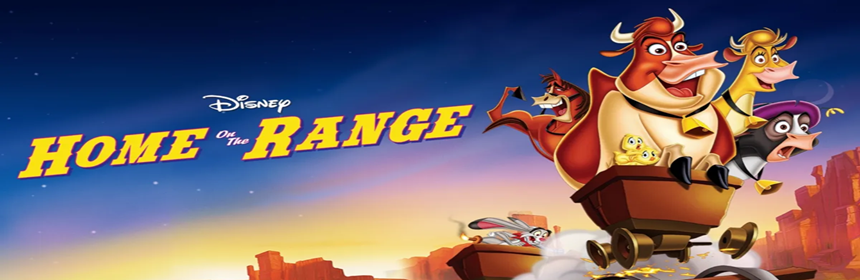
As mentioned in the first blog post in this series, I’ll be writing analysis content on all 60+ Disney animated feature films and their film making eras.
The sixth era is the Post-Renaissance Era, which ran from 1999 to 2008 and started with Fantasia 2000. As mentioned in a previous blog post, the Post-Renaissance Era is known for: its experimentation with both computer-generated (CG) animation (and alternating between traditional hand-drawn and CG animation), and its experimentation with storytelling.
The Post-Renaissance Era is also referred to as Disney’s Second Dark/Bronze Age and Experimental Era.
So how well did Home on the Range measure up to these famous features?
Experimentation with computer-generated (CG) animation (and alternating between traditional hand-drawn and CG animation):
This is the last film in this era to be traditionally animated and the last Disney animated feature film ever to use the CAP System, which was established and heavily used in the previous era. Disney wouldn’t release another traditionally animated film until 2009, with the release of The Princess and the Frog, which would kick off Disney’s next era.
I personally felt that the design and animation of this film was inconsistent – most of it looked geometric and was Looney Tunes-like in nature, the apple trees were detailed and yet the bees were very basic, the shadow of the animals on the ground and subtle sounds of the cowbell movement were good, however I felt that the surreal animation of the cows being hypnotised was out of place (and reminded me of similar examples of surrealism from previous films).
Experimentation with storytelling:
The experimentation with storytelling in this film was most obvious in its Western setting (a rare setting for Disney) and the protagonists being the animals not the humans, as well as the animals trying to solve a problem for humans.
According to the film’s IMDb page, screenwriters, Will Finn and John Sanford, originally pitched the film as an animated feature film based on the myth of the Pied Piper. Maggie was originally written as a deaf girl. Michael Eisner immediately hated the idea, because he thought no parent would take their children to see a film where children are murdered. So Finn and Sanford wrote what would become this film, which contains elements from the Pied Piper myth.
According to the film’s Wikipedia page, the film’s plot underwent many changes from being about a young boy from the Far East whose father owns a railroad and sends him to Western United States to teach him maturity, to a supernatural western about a timid cowboy who visits a ghost town and confronts an undead cattle rustler named Slim, to a story about a little bull named Bullets that wanted to be more like the horses that led the herd, to the final product that is this film.
My overall thoughts:
Full disclosure, I wasn’t looking forward to watching this film as I’d heard how bad it was many times, including when it was first released. Unfortunately, I agree with the consensus.
Roseanne Barr’s narration didn’t fit, and neither did the modern jokes against the 19th century setting. The jokes were juvenile, the “comedic” elements were too slapstick and nonsensical, the tone was inconsistent and gave me whiplash, and the plot hard to follow. The writers’ attempts to be emotional, deep and heartfelt with the flash flooding sequence at the halfway point felt too little too late. I found it hard to be invested in the emotional stakes the writers were trying to raise when the tone of the film was uneven and mostly silly.
The overall concept of the film and its plot had potential and probably would have been better received if it had been better executed and wasn’t aimed towards a younger audience. I can see why it’s viewed as Disney’s worst animated feature film, and thankfully its running time is short.
The next part of the Disney Era Analysis series will focus on Chicken Little.
Fun Facts and Trivia (according to the film’s IMDb page):
- This film was so poorly received by critics and audiences that Art Director, Michael Giaimo, was fired from Disney.
- Lucky Jack is a jackrabbit with a peg-leg and incredibly bad luck, implying that someone took one of his feet, and with it, all of his good luck.
- This film marked Patrick Warburton’s first voiceover role as a character with the same name, ironically though, Patrick’s name is never used at all throughout the film.
- This is the last Disney animated feature film with the release year in Roman numerals in the copyright holder of the ending credits.
- The first spoken words in the movie are actually the title of the movie. Maggie opens by saying “Home on the range…” to then explain she’s between homes right now.
- This is the final Disney animated feature film (in the animated feature film canon) to be publicly released on VHS.
- Maggie, Grace, and Mrs. Calloway are the only actual cows seen in the film. The others that Slim and the Willies have been seen rustling are actually longhorns.
References:

