Disney Era Analysis – Brother Bear
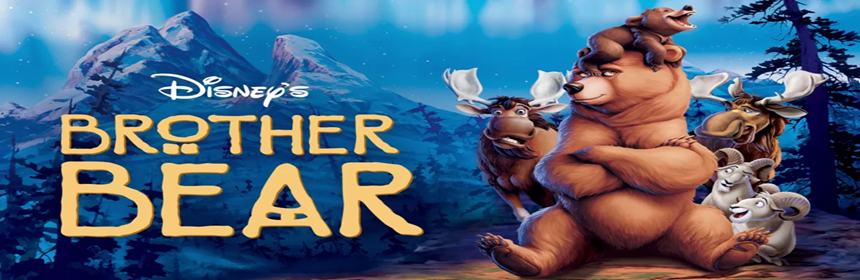
As mentioned in the first blog post in this series, I’ll be writing analysis content on all 60+ Disney animated feature films and their film making eras.
The sixth era is the Post-Renaissance Era, which ran from 1999 to 2008 and started with Fantasia 2000. As mentioned in a previous blog post, the Post-Renaissance Era is known for: its experimentation with both computer-generated (CG) animation (and alternating between traditional hand-drawn and CG animation), and its experimentation with storytelling.
The Post-Renaissance Era is also referred to as Disney’s Second Dark/Bronze Age and Experimental Era.
So how well did Brother Bear measure up to these famous features?
Experimentation with computer-generated (CG) animation (and alternating between traditional hand-drawn and CG animation):
According to the film’s Wikipedia page, this film is traditionally animated, but does include some CG animation, such as a salmon run and the caribou stampede. The animators did a life drawing session with live bear cubs, as well as outdoor drawing and painting sessions at Fort Wilderness in Florida for two months. The film’s background supervisor and his team also travelled to Wyoming and studied with a Western landscape painter where they learned to “simplify objects by getting the spatial dimensions to work first, and working in the detail later”.
According to the film’s IMDb page, this is the last Disney animated feature film to be made with traditional hand-drawn animation until the release of The Princess and the Frog in 2009.
Experimentation with storytelling:
One of the film’s most notable features is the use of aspect ratio as a storytelling device. The film begins at the standard widescreen aspect ratio of 1:75:1 whilst Kenai is human with a muted colour palette, and changes to an anamorphic aspect ratio of 2:35:1 with a more vibrant and fanciful colour palette, once he transforms into a bear.
Another feature of this film’s storytelling is Sitka’s spirit, in the form of an eagle, which can be seen throughout the film at the following moments:
- After Kenai first wakes up as a bear, an eagle is sitting on a tree branch watching him and then flies off.
- When Kenai and Koda are riding on mammoths and Koda says ‘he always wanted a brother’, the camera moves up to reveal an eagle sitting on a tree branch.
- When Kenai and Koda are going through the lava path, after they walk offscreen, an eagle flies after them.
- An eagle meets up with Denahi in the mountains, just as he says he needs help.
My overall thoughts:
Full disclosure, I’ve seen this film many times before – firstly, when it was released in cinemas, and then multiple times after I received the VHS copy for my 14th birthday, and then at least once on DVD a little over a decade earlier. I’ve always loved this film.
In terms of my thoughts on the film as part of this analysis series, the traditional animation reminded me of films in the previous Era, and the animation of the Great Spirits and the landscape were absolutely beautiful.
In terms of its storytelling, I appreciated the full circle nature, such as the film starting with Denahi as an elderly shaman telling Kenai’s story to his people, and ending with the younger him becoming a shaman. I also appreciated the various uses of the totems, such as: Sitka becoming an eagle after his death, the wisdom of Kenai’s story leading to Denahi living up to his own totem, and of course, the obvious focus on bears, with Kenai’s totem used to identify him to the humans at the end. I also appreciated the subtlety of Sitka’s facial expressions and the fact that his spirit was silent, as well as the twist and getting Koda’s mother’s perspective on the hunt. On smaller notes, I appreciated the comic relief that Rutt and Tuke, and the rams provided. I also loved the bloopers during the end credits.
Overall, whilst this film isn’t as much of a blockbuster or classic as other Disney animated feature films, it’s a solid film with a simply structured, but beautifully and powerfully told story.
The next part of the Disney Era Analysis series will focus on Home on the Range.
Fun Facts and Trivia (according to the film’s IMDb page):
- Most of the characters are named after actual places in Alaska, where the story is set. For example, Kenai is named after the Kenai Peninsula.
- This film is the first Disney animated feature film to have a post-credits scene.
- In the film’s DVD commentary, Rutt and Tuke comment that if Kenai had bothered to tie up the basket with the fish properly, it’s possible that most of the film never would have happened.
- Kenai’s age is never stated, though he is most likely about 16, as 12-16 is considered the age of manhood in First Nation tribes.
- Joaquin Phoenix’s first and currently only animated film role.
- Denahi was originally going to be Kenai’s father instead of his older brother.
References:

