Disney Era Analysis – Treasure Planet
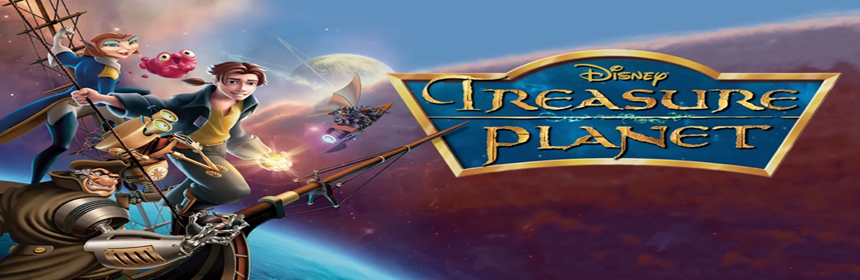
As mentioned in the first blog post in this series, I’ll be writing analysis content on all 60+ Disney animated feature films and their film making eras.
The sixth era is the Post-Renaissance Era, which ran from 1999 to 2008 and started with Fantasia 2000. As mentioned in a previous blog post, the Post-Renaissance Era is known for: its experimentation with both computer-generated (CG) animation (and alternating between traditional hand-drawn and CG animation), and its experimentation with storytelling.
The Post-Renaissance Era is also referred to as Disney’s Second Dark/Bronze Age and Experimental Era.
So how well did Treasure Planet measure up to these famous features, and was it the right film to mark the halfway point of the Era?
Experimentation with computer-generated (CG) animation (and alternating between traditional hand-drawn and CG animation):
According to the film’s Wikipedia page, one of the film’s goals was to blend different mediums of animation into one film to have such a seamless finish that viewers couldn’t tell the difference between what was 2D hand-drawn animation and 3D CG animation. The film ended up incorporating three animation mediums – traditional 2D character animation, 3D character animation, and 3D CG environments. The ship was created using the “Deep Canvas” technique that was developed for Tarzan in the previous Era.
The film’s Wikipedia page also stated that the crew operated on the rule that the overall look of the film’s artwork should be 70% traditional and 30% sci-fi. Animators also used maquettes (small statues of the characters) as references throughout the animation process.
According to the film’s IMDb page, the film’s overall look was based on 19th century oil paintings. The film’s IMDb page also states that the animators visited a Benihana restaurant to take notes for the scene where John Silver chops shrimp.
My favourite animation moments in this film include: the animation of the illustrations in the book, the animation of the map, and the animation of the different doorways.
Experimentation with storytelling:
This film is a sci-fi adaptation of Robert Louis Stevenson’s novel, Treasure Island, and Disney’s third adaptation of the novel.
According to the film’s IMDb page, some of the writing of the father-son-like relationship between Silver and Jim was inspired by animator, Glen Keane’s, relationship with an assistant coach on his high school’s football team. The film’s IMDb page also states that Mr Scroop is a combination of many characters from the novel, including Israel Hands and George Merry.
My overall thoughts:
Overall, I felt that this film was an interesting combination of traditional animation and storytelling, sci-fi, and modern animation and storytelling. I felt that the animators achieved their goal of seamlessly animating three animation mediums at once, and the animation alone makes it a perfect film to mark the halfway point of the Era, as it showcases a peak of Disney’s experimentation with traditional hand-drawn and CG animation.
However, I did feel that the film was too slow paced in the first half, B.E.N was introduced too late and a little annoying, and that Silver’s characterisation was inconsistent. This was Disney’s third sci-fi based movie in this Era (after Atlantis: The Lost Empire and Lilo & Stitch) and I felt that this sci-fi based film was less grounded than Lilo & Stitch but more engaging than Atlantis: The Lost Empire.
The next part of the Disney Era Analysis series will focus on Brother Bear.
Fun Facts and Trivia (according to the film’s IMDb page):
- The name of the ship, R.L.S Legacy, is a reference to the book’s author, Robert Louis Stevenson.
- The contest between Jim and Silver, each coaxing Morph to come to them so they could obtain the map, was ad-libbed.
- When B.E.N. gets his memory back you can briefly hear the classic Windows error beep.
- Costing $140 million, this is the most expensive traditionally animated film ever made.
- The planet Jim is from is called Montressor, a name having Italian origins meaning “My Treasure”.
References:

