Disney Era Analysis – Lilo & Stitch
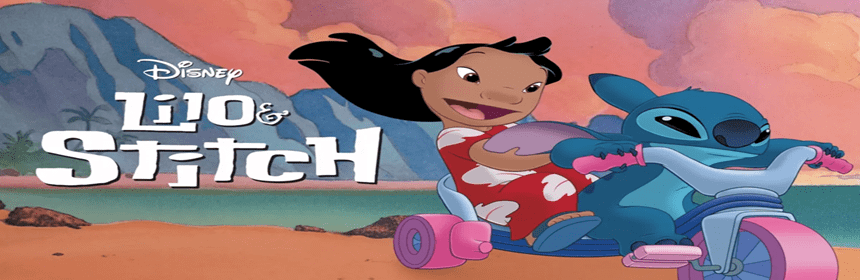
As mentioned in the first blog post in this series, I’ll be writing analysis content on all 60+ Disney animated feature films and their film making eras.
The sixth era is the Post-Renaissance Era, which ran from 1999 to 2008 and started with Fantasia 2000. As mentioned in a previous blog post, the Post-Renaissance Era is known for: its experimentation with both computer-generated (CG) animation (and alternating between traditional hand-drawn and CG animation), and its experimentation with storytelling.
The Post-Renaissance Era is also referred to as Disney’s Second Dark/Bronze Age and Experimental Era.
So how well did Lilo & Stitch measure up to these famous features?
Experimentation with computer-generated (CG) animation (and alternating between traditional hand-drawn and CG animation):
This film’s obvious experimentation with animation was via using watercolour painted backgrounds, as opposed to the traditional gouache technique. Watercolours hadn’t been used since Disney’s early animated shorts and early animated features: Snow White and the Seven Dwarfs, Pinocchio, and Dumbo. Director, Chris Sanders, preferred the watercolour backgrounds to evoke the bright look of a storybook and the background artists were required to be trained in the medium. I was honestly surprised to read that watercolour backgrounds hadn’t been used since Dumbo, as some films I’ve reviewed for this series have a watercolour-like appearance and design.
The animation in this film was traditional, hand-drawn and 2D, as opposed to computer-generated, due to its limited budget. This led to character designs being minimised (such as clothing), and background characters were designed but not animated (i.e. moving).
Another interesting experiment with the animation was the appearance of a real picture of Elvis amongst the animated characters and background.
My favourite animation moments in this film were: a robot alien at the beginning of the film vomiting parts in disgust at what Stitch said to the Grand Councilwoman, the way Lilo walked up the stairs after her fight with Nani, Stitch building San Francisco out of books and destroying it like Godzilla, Stitch bringing the surfboard to Lilo on the beach, and the transparency of the ocean during the Hawaiian Roller Coaster Ride scene.
One animation sidenote that I couldn’t ignore was the replacement of the dryer that Lilo hides in from Nani, to a wooden cabinet with no door and a pizza box that Lilo hides in, instead.
Experimentation with storytelling:
According to the film’s IMDb page, Director, Chris Sanders, had created the character of Stitch in 1985 for what ended up being an unsuccessful pitch for a children’s book.
Originally, Stitch was intended to be an intergalactic gangster and Jumba was envisioned as a disgruntled member of his gang that had been left behind during a heist and sought revenge on Stitch. This idea was abandoned as the filmmakers decided that Stitch would be more sympathetic if he was younger and was changed to be a genetic experiment, so Jumba was changed to be the scientist who created him.
Interestingly, this is one of few Disney animated feature films with no actual villains – Jumba was hired to capture Stitch (a wanted fugitive), Captain Gantu was hired after the Grand Councilwoman fired Jumba and Pleakley, and Cobra Bubbles was only doing his job and expressing concern for Lilo’s welfare. Meanwhile, Stitch was an anti-hero, not a villain, who managed to grow and redeem himself.
One little storytelling detail I appreciated, which showed the progression of Stitch’s character, was the frog on the road. When Stitch lands on Earth, he points his gun at the frog, towards the end of the film when Stitch is trying to save Lilo and is knocked out on the road, the frog wakes him up and warns him about Captain Gantu, and Stitch saves the frog from him.
My overall thoughts:
Full disclosure, I have seen this film before, although I can’t remember exactly when. I also had the PS1 game of this film and enjoyed playing it.
This film is Disney’s continuation of experimentation in science fiction, following Atlantis: The Lost Empire, but in a present-day and more grounded setting. It achieved its job in its desire to evoke a nostalgic feeling for older Disney animated feature films in its animation and design, it feels like a comfy film to me. It’s also a film that has more depth than it appears, with its themes of loss and belonging, which were relatable, heartbreaking, and towards the end of the film, turned heartwarming.
On a sidenote, the film’s marketing campaign involved both promoting this film and celebrating the films that came before it, with Stitch being inserted in famous scenes in films from the Renaissance Era and even interacting with the characters. It’s funny to watch, was and is one of the smartest marketing campaigns I’ve ever come across.
The next part of the Disney Era Analysis series will focus on Treasure Planet.
Fun Facts and Trivia (according to the film’s IMDb page):
- The sandcastle Nani, Lilo and David build together during “Hawaiian Roller Coaster Ride” is a replica of the Sleeping Beauty Castle found at Disneyland and Hong Kong Disneyland.
- Nani has several surfing trophies and medals in her room, indicating that she was a surfing star but dropped everything to take care of Lilo when their parents died.
- The film’s extra-terrestrial elements, such as spaceships, were designed to resemble marine life.
- Earth is referred to as being in Section 17, Area 51 in the Galactic charts, one of several references to Area 51.
- When Stitch messes up Lilo’s room, she gently places a white lei around his neck and he immediately falls into a tranquil-like state. White leis represent love, as Stitch eventually becomes a better person by Lilo gently showing him platonic love.
- This film is the first Disney animated feature film to be set in Hawaii.
- Many of the background aliens have been designed based on Winnie the Pooh characters.
- Stitch, Jumba and Nani were originally going to hijack a commercial plane to rescue Lilo. However, this was drastically changed due to the events of 9/11.
- Lilo is adamant that she feeds Pudge the fish a peanut butter sandwich every Thursday. Most viewers believe that Pudge is never seen, however, right before the title appears in the opening credits, you see Lilo underwater and Pudge swim by with the sandwich in his mouth.
- When Stitch rips up a drawing of Lilo’s, she exclaims, “No! That’s from my blue period!” referencing Pablo Picasso.
- This is one of the few Disney animated feature films to take place in the present day.
- When a mosquito feeds on Pleakley’s blood, he says the insect is a ‘she’. This is proven correct as only the females suck blood out of their victims.
- The kennel owner tells Lilo that “Stitch” is not a good name for a dog before adding “…in Iceland”. Between 1924 and 1984, it was illegal to own a dog in Reykjavik, Iceland’s Capital and largest city.
- This was David Ogden Stier’s (Jumba) last Disney animated feature film before his death in 2018. He also provided voice work in Beauty and the Beast, Pocahontas, The Hunchback of Notre Dame, and Atlantis: The Lost Empire.
References:

