Disney Era Analysis – Atlantis: The Lost Empire
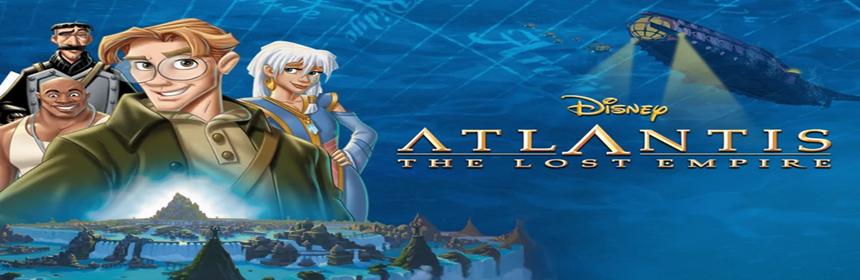
As mentioned in the first blog post in this series, I’ll be writing analysis content on all 60+ Disney animated feature films and their film making eras.
The sixth era is the Post-Renaissance Era, which ran from 1999 to 2008 and started with Fantasia 2000. As mentioned in a previous blog post, the Post-Renaissance Era is known for: its experimentation with both computer-generated (CG) animation (and alternating between traditional hand-drawn and CG animation), and its experimentation with storytelling.
The Post-Renaissance Era is also referred to as Disney’s Second Dark/Bronze Age and Experimental Era.
So how well did Atlantis: The Lost Empire measure up to these famous features?
Experimentation with computer-generated (CG) animation (and alternating between traditional hand-drawn and CG animation):
According to the film’s Wikipedia page, this film is one of few Disney animated feature films produced and shot in 35mm anamorphic format, as the directors felt that a widescreen image was crucial as a nostalgic reference to old action-adventure films presented in the CinemaScope format.
The film’s Wikipedia page also states that at the time of its release, it was notable for using more computer-generated imagery (CGI) than any other Disney animated feature film. However, to increase productivity, the directors had the digital artists work with traditional animators throughout the production. The final film included 362 digital-effects shots, and computer programs were used to seamlessly join the 2D and 3D artwork.
My favourite animated moment in the film was the scene of Milo and Kida underwater, deciphering the mural.
Experimentation with storytelling:
The plot of this film is loosely inspired by the legend of Atlantis, which was introduced in Plato’s Timaeus and Critias. This is made clear in the film’s opening moments when the following Plato quote about Atlantis is shown on screen:
“…in a single day and night of misfortune, the island of Atlantis disappeared into the depths of the sea.” (Plato, 360 B.C.)
It’s also made clear when Milo comments that the Shepherd’s journal cuts off, like there’s a page missing, as Plato’s narrative of Atlantis also cuts off mid-sentence. The film was also inspired by Jules Verne’s novels, specifically Twenty Thousand Leagues Under the Sea and Journey to the Center of the Earth.
According to the film’s IMDb page, the crew’s goal for this film was to make a big, fun, action-adventure epic film, which led to the idea of a group of adventurers and explorers going into the centre of the Earth to find something.
One obvious form of experimentation with the film’s storytelling was the characterisation of Rourke as a villain. Instead of making him the usual, cliché villain, they wanted his character to have complexity by not making him inherently evil, but rather greedy.
My overall thoughts:
This film was Disney’s first foray into science fiction, and an attempt to appeal to an older audience. Overall, I felt that the film did a good but not great job at this.
The halves of the film were firmly split, with the first half establishing the premise and characters (which was necessary) but was done too slowly for my taste. However, I appreciated that Atlantis was found relatively early in the film, as opposed to being saved until the end, which led to a decent exploration of the Empire. I also appreciated that the film’s pace picked up in the second half.
I also appreciated that the film’s battle scene, and by extension the Atlantean’s and Milo’s victory against Rourke, was won using brains and not the cliché brawn.
The next part of the Disney Era Analysis series will focus on Lilo & Stitch.
Fun Facts and Trivia (according to the film’s IMDb page):
- Because the film was planned out as an action-adventure, the production crew wore t-shirts to work that read ‘ATLANTIS – Fewer songs, more explosions’.
- The written Atlantean language is to be read left to right, drop down a line, and read right to left, continuing this cycle. It was done to create a flowing, water-like movement reminiscent of the Atlantean culture.
- This is one of the last Disney animated featurefilms to feature a character that smokes.
- Milo Thatch is the first male hero in a Disney animated feature film to wear glasses.
- One of the few Disney animated feature films to take place in an actual year (1914).
- One of the first Disney animated featurefilms to feature an African-American character as an important secondary character.
- As of 2020, this film still holds the record for being the full-length Disney animated feature film with the highest body count.
- The character of Lt. Helga Katrina Sinclair was screenwriter, Tab Murphy’s, tip of the hat tribute to the femme fatales of the film noir genre of the 1940s.
- The climactic battle was originally supposed to take place only on land. The filmmakers decided to put the battle in the air instead, to create a more dramatic and exciting sequence.
- Towards the end of the film when all of the characters are dressed nicely with the professor and discussing what happened to Milo/Rourke/Helga, they all wear their crystal gifts differently – Vinny as an earring, Audrey on her necklace, Sweet on his tie, Cookie as a tooth, and Mrs. Packard in her hat.
- Milo is one of the few characters in a full-length Disney animated feature film who takes an active role in defeating the main villain.
References:

