Disney Era Analysis – Wreck-It Ralph
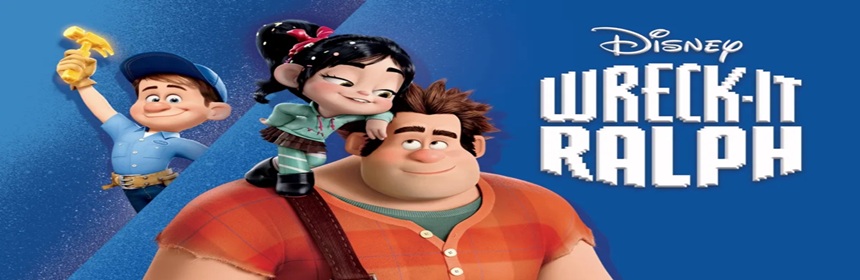
As mentioned in the first blog post in this series, I’ll be writing analysis content on all 60+ Disney animated feature films and their film making eras.
The seventh era is the Revival Era, which ran from 2009 to 2019 and started with The Princess and the Frog. As mentioned in a previous blog post, the Revival Era is known for: its return to the “old formula” (storytelling similar to the Renaissance Era), improved and advanced computer-generated (CG) animation, evolution in its storytelling by adapting stories from sources other than old books, and well thought-out stories paired with improved animation.
So how well did Wreck-It Ralph measure up to these famous features?
Return to the “old formula” (storytelling similar to the Renaissance Era):
This film returned to the “old formula” in the following ways:
- The “I Want” nature of the protagonist’s journey is present with Ralph wanting to get a medal to prove he’s a good guy to the Nicelanders.
- World building – the video game universe is heavily detailed and diverse, and has rules all the characters have to abide by.
- Ralph is an underdog on a journey of self-discovery.
Improved and advanced computer-generated (CG) animation:
According to the film’s Wikipedia page, this film introduced a new animation technique that Disney implemented – bidirectional reflectance distribution functions. This technique provided more realistic reflections on surfaces and paired with then-new virtual cinematography system, Camera Capture, made it possible to go through scenes in real time.
My personal favourite animation moments were: the contrast of the 8-bit game animation surrounded by the modern crisp look of the arcade cabinet the games were housed in, the animation of the characters leaving the Bad-Anon meeting, the animation inside the game from behind the arcade cabinet’s screen, and the design of Game Central Station. I also felt that the characters travelling to other games via the power strip the games are plugged into, and the concept of Game Central Station was genius.
Evolution in its storytelling by adapting stories from sources other than old books:
This film is Disney’s first animated feature film set in the video game universe. Despite cameos from various well-known video game characters, the story features original characters and video games. According to the film’s IMDb page, Disney first began developing an animated feature film about the world of video game characters in the 1980s.
Interestingly, the story does a brief 30-year time jump (with the film coming out in 2012, it’s assumed Fix It Felix Jr. was released in 1982), with the film’s writers inspired by the 1981 Nintendo game, Donkey Kong.
According to the film’s IMDb page, director, Rich Moore, was inspired to create the character of Vanellope after reading Sarah Silverman’s (Vanellope’s voice actor) memoir.
Well thought-out stories paired with improved animation:
The film’s video game setting had a ripple effect on the film’s animation.
According to the film’s IMDb page, initially the crew considered keeping all the characters in their native graphic quality, which would mean that Ralph would look 8-bit the entire time, however it was deemed too difficult for making Ralph a sympathetic, lovable character. Ralph and Felix are the only characters from their game who don’t move in an 8-bit style outside of game play.
The film’s IMDb page also states that the film’s animators essentially had to unlearn everything they’d been taught about animating character movements to animate the characters from Fix It Felix Jr. movement’s in 8-bit style.
I also appreciated the dialogue from Felix as he is admiring Calhoun’s high-definition design.
My overall thoughts:
Overall, I felt that this film was quite a clever one, in comparison to the previous entries in the Era at this point (not that they weren’t clever). It was the first film of the Era to consist of an original story and be based in the video game universe, and it enabled the film to contain a variety of characters, pop culture references, and a new detailed world to be established and explored.
Despite its child-like aesthetic and jokes, this film is more mature and contains a lot more depth than meets the eye – Ralph attends a “Bad-Anon” meeting (an AA-like meeting/support group for “Bad Guys”) where the concept of not being able to change who you are is explored, Ralph is having an existential crisis due to a significant milestone in his life, and the video game universe’s “bad guy” nature actually serving a purpose is an original concept. There is also depth in Vanellope’s situation, being ostracised by society due to being a glitch (different), and King Candy essentially brainwashing Sugar Rush’s citizens.
Despite the heavy nostalgia present, this film was quite modern and contemporary, in comparison to its predecessors in this Era (so far).
The next part of the Disney Era Analysis series will focus on Frozen.
Fun Facts and Trivia (according to the film’s IMDb page):
- The train station of Niceland shows that the population is 224×256, the common resolution of an 8-bit game.
- The graffiti in Game Central Station contains many inside jokes and references to famous video games.
- The thug, Vladimir, from Tangled can be found in Game Central Station.
- There are 188 classic video game characters featured in the film.
- Ralph, Felix, Vanellope, and Calhoun all resemble their respective voice actors.
- The design of Game Central Station is modelled after New York City’s Grand Central Station Terminal.
- Jennifer Lee, one of the film’s two screenwriters, became the first woman to write a screenplay for a Disney animated feature film since Noni White for Tarzan.
- The four main characters don’t come together until 1 hour, 22 minutes into the film, when Sugar Rush is being evacuated.
- Calhoun and Vanellope never talk to each other throughout the film, and only interact once when Calhoun holds Vanellope’s hand for a few seconds on the rainbow bridge.
References:

