Disney Era Analysis – Tangled
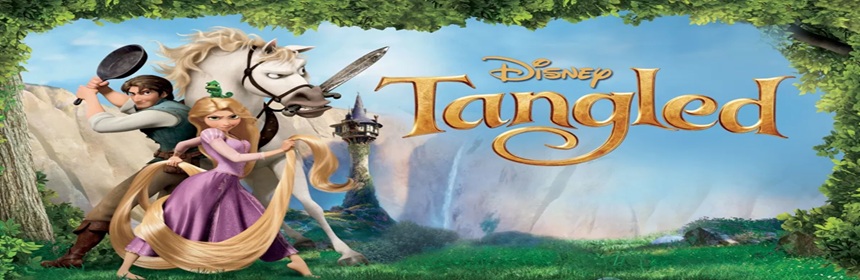
As mentioned in the first blog post in this series, I’ll be writing analysis content on all 60+ Disney animated feature films and their film making eras.
The seventh era is the Revival Era, which ran from 2009 to 2019 and started with The Princess and the Frog. As mentioned in a previous blog post, the Revival Era is known for: its return to the “old formula” (storytelling similar to the Renaissance Era), improved and advanced computer-generated (CG) animation, evolution in its storytelling by adapting stories from sources other than old books, and well thought-out stories paired with improved animation.
So how well did Tangled measure up to these famous features?
Return to the “old formula” (storytelling similar to the Renaissance Era):
This film returned to the “old formula” in the following ways:
- Mother Gothel is very similar to Judge Claude Frollo from The Hunchback of Notre Dame – both have no magical powers, both keep a person hostage for their own personal gain, both sing a song to their hostage to keep them from running away, and both try to kill their hostage’s love interest.
- Rapunzel is an official Disney Princess.
Improved and advanced computer-generated (CG) animation:
According to the film’s Wikipedia page, the film was made using CG imagery, although was modelled on the traditional look of oil paintings on canvas, with the Rococo paintings of French artist, Jean-Honore Fragonard, used as a references for the film’s artistic style. To create the impressions of a painting, non-photorealistic rendering was used.
The film’s Wikipedia page also states that the film was made in 3D, CGI animation but in a way as to become an extension of the traditional 2D Disney “aesthetic”. Animator, Glen Keane, wanted the computer to become as pliable as the pencil and not have the computer or CG animation dictate the artistic style and look of the film.
Evolution in its storytelling by adapting stories from sources other than old books:
This film is an adaptation of the Brothers Grimm fairy tale, Rapunzel, which was published in their 1812 collection, Grimms’ Fairy Tales. According to the film’s Wikipedia page, Disney’s earlier efforts to adapt Rapunzel into an animated feature film were stalled as the original fairy tale was viewed as “too short”. Eventual solutions to this issue to get to the film that we have today were the mysterious floating lanterns, Rapunzel’s desires to see them outside of the tower, and Rapunzel making the deal with Flynn to get her to the kingdom to do so.
Well thought-out stories paired with improved animation:
According to the film’s Wikipedia page, existing technology at the time presented many difficulties, especially when it came to animating Rapunzel’s hair. Senior software engineer, Kelly Ward, spent six years writing programs to make it move the way the crew wanted it to. The directors were initially unsure if the length of Rapunzel’s hair was going to work, but the problems it caused were resolved via an improved version of a hair simulation program called Dynamic Wires, which was originally developed for Bolt.
Considering how much of a focal point Rapunzel’s hair is to her character and the film’s plot, the solution they found was clearly the right one and allowed to them to not only animate the hair the way they needed to, but also in a way that it became its own character, enabling crucial turning points and well-needed humour.
My overall thoughts:
Overall, I thought that this film, with its smooth 3D CGI animation, and its clever adaptation of its source material, was a step up from The Princess and the Frog.
I appreciated the lighting and colour palette changes with Gothel’s interactions with Rapunzel, as well as when she becomes increasingly sinister as the film progresses. I also appreciated the contrast with the presence of lights and the lanterns with Rapunzel and her emerging relationship with Flynn.
I also appreciated the sometimes more adult and subtle humour, such as Flynn joking about hay fever and allergies with a palace guard as he steals the crown, the running gag of the wanted posters mocking Flynn’s appearance (specifically his nose), and the password joke made by Shorty at the start of Flynn’s rescue sequence.
The next part of the Disney Era Analysis series will focus on Winnie the Pooh.
Fun Facts and Trivia (according to the film’s IMDb page):
- Whenever Mother Gothel expresses her “love” to Rapunzel, it is always to her hair and not directly to Rapunzel. She kisses Rapunzel on the head and touches her hair whenever expressing love. By contrast, whenever Flynn is being affectionate to Rapunzel, he always brushes her hair away, so he can see her face better.
- While recording Rapunzel confessing her love to Eugene/Flynn and singing the healing song, Mandy Moore was actually in tears.
- The three books in Rapunzel’s tower are Botany, Geology and Cooking.
- There are two Stabbington Brothers, but only one of them ever talks. The one with the sideburns says every line and the one with the eye patch never speaks.
- This is the first instalment of Disney’s CGI animated musical universe franchise.
- In contrast to everyone else in the movie, Mother Gothel wears a Renaissance-era dress, as the magic of the flower and Rapunzel’s hair has preserved her youth for centuries.
- In the lantern scene, the streets light up in the same way Rapunzel’s hair does.
- In the tower, Gothel’s bedroom has a door while Rapunzel’s bedroom doesn’t, only curtains. This means that Rapunzel can never shut Gothel out, while Gothel always has the option.
- Composer, Alan Menken, reported that he based the film’s musical score on 1960s rock.
- Rapunzel’s parents have no spoken dialogue in the film.
- Over 45,000 lanterns were created for the “I See the Light” sequence.
- Mother Gothel spends the majority of the film rejuvenating herself with increasing frequency, suggesting that the healing song/spell is isn’t working as well.
- Eugene/Flynn is 23, while Rapunzel is 18.
References:

