Disney Era Analysis – The Adventures of Ichabod and Mr. Toad
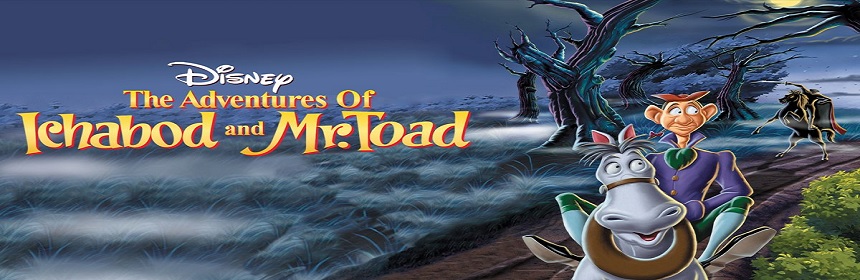
As mentioned in the first blog post in this series, I’ll be writing analysis content on all 60+ Disney animated feature films and their film making eras.
The second era is the Wartime Era, which ran from 1943 to 1949 and started with Saludos Amigos. As mentioned in a previous blog post, the Wartime Era is also known as the “package era” as the films during this era were famous for consisting of multiple segments or short films with varying plots (or sometimes no plots at all) that were put together, as opposed to being a film focusing on or telling one concrete story. This era was also known for combining live action with animation. This era was also known for showing how World War II affected the Walt Disney Animation Studios.
So how well did The Adventures of Ichabod and Mr. Toad measure up to these famous features, and was it the right film to end the Wartime Era?
Consisting of multiple segments or short films with varying plots (or sometimes no plots at all) that were put together:
The Adventures of Ichabod and Mr. Toad consisted of two short films/segments and are based on two literary works: The Wind and the Willows, and The Legend of Sleepy Hollow.
The Wind in the Willows:
This segment is based on the 1908 novel of the same name and takes place in London, England, from June 1907 until New Years’ Day 1908.
This segment tells the story of J. Thaddeus Toad, aka Mr. Toad, who is the wealthy owner of Toad Hall, although is on the brink of bankruptcy due to his adventures and “manias” for various fads. His friend, Angus McBadger, agrees to volunteer as his accountant to help him pay his bills and keep Toad Hall.
McBadger asks Mr. Toad’s best friends, Rat and Mole to talk Mr. Toad out of his latest mania of riding a horse and cart around the countryside. However they are unable to get him to change his mind, instead he develops a new mania for a motor car when it passes by him.
Rat and Mole resort to locking Mr. Toad in his bedroom, however he manages to escape out the window. He ends up going to a tavern and giving the deed to Toad Hall in exchange for the motor car, to a gang of weasels.
When Mr. Toad is arrested for car theft, he represents himself in court. After getting his horse, Cyril, to be his star witness in which he tells the court what happened the night Mr. Toad escaped from his bedroom, Mr. Toad asks Mr. Winkie to take the stand and confirm what happened, only for Mr. Winkie to tell the court that Mr. Toad stole the car and sold it to him. Mr. Toad is found guilty and sent to jail.
Months pass by, and Mr. Toad’s friends make multiple efforts to appeal the case to no avail. On Christmas Eve, Cyril visits Mr. Toad disguised as his grandmother and gives him a disguise so he can escape. He manages to escape, stealing a train to get away from the police. Meanwhile, McBadger visits Rat and Mole to tell them he has discovered that Mr. Winkie is the leader of the weasel gang and they have taken over Toad Hall. They go to Toad Hall to try and get the deed off Mr. Winkie, which has Mr. Toad’s signature, proving he owns Toad Hall. They sneak into Toad Hall and after the weasel gang chase them around the estate, they manage to escape with the deed.
The segment ends on New Years Day, with Mr. Toad having regained Toad Hall. McBadger, Rat, and Mole celebrate the new year believing that Mr. Toad has reformed, only to discover Mr. Toad and Cyril flying away on a plane, as Mr. Toad now has a new mania for planes.
The Legend of Sleepy Hollow:
This segment is based on the 1820 short story of the same name and focuses on Ichabod Crane, a lanky schoolmaster who moves to Sleepy Hollow. His quirks make him the target of town bully and hero, Brom Bones. Despite his quirks and appearance, he manages to become quite the ladies’ man and develops a rapport with his students.
One day, Ichabod meets and falls in love at first sight with a young woman named Katrina, the daughter of wealthy man, Baltus van Tassel. However, even though he seems to be in love at first sight, it’s clear that he wants to marry her to steal her family’s money and farm. Ichabod and Brom fight for Katrina’s affection, whilst Katrina enjoys the spectacle of their efforts.
Both Ichabod and Brom are invited to the van Tassel Halloween party, Brom tries to get Ichabod to dance with another woman and have him fall through a cellar door, to get him away from Katrina, but this doesn’t work. When Brom discovers during dinner that Ichabod is superstitious, he tells him the tale of the Headless Horseman. Brom tells him that the Horseman travels through the woods on every Halloween, searching for a living head to replace the one he has lost, and the only way to get away from the Horseman is to cross over a covered bridge.
When Ichabod travels home on his horse, every sound startles him and he starts to panic. Whilst travelling through an old cemetery, he believes he can hear the sound of a horse galloping after him, only to discover that he’s hearing a plant bumping against a log. He laughs this off, only to come across the real Horseman. The Horseman chases after him and whilst Ichabod finds a covered bridge and thinks he got away, the Horseman throws a jack-o-lantern at Ichabod and hits him.
The next morning Ichabod’s hat is found at the bridge next to the shattered jack-o-lantern. Rumours spread that Ichabod either left Sleepy Hollow and married a wealthy widow, or had been killed by the Horseman, as he was never seen again. Sometime later, Brom and Katrina marry.
The segments ends with the Headless Horseman laughing maniacally and scaring the film’s narrator into closing the book and putting it back on the shelf.
Combining live action with animation:
The only live action present in the film is at the beginning, between the segments, and the end where a house is shown, with a library that is filled with many books. The live action is used as bookends for the film, as well as to break up the segments by pulling The Wind in the Willows and Ichabod Crane off bookshelves, to show that they are based on literary works.
Showing how World War II affected the Walt Disney Animation Studios:
Work on the film, specifically The Wind in the Willows segment, commenced in April 1941. It was eventually brought to a halt due to many factors including financial problems Disney was experiencing and the low quality of the film at the time. Production resumed in 1946 after the War ended.
According to IMDb, there is a rumour that one animator stopped working on The Wind in the Willows to join the Army during World War II and then returned four years later to continue his work. This animator is believed to be Frank Thomas.
My overall thoughts:
Overall, I felt that The Adventures of Ichabod and Mr. Toad was a good choice to end the Wartime Era due to only having two segments which were grounded by being based in literary works, with the live action limited to bookending the film as well as breaking up the segments.
However, despite my above thoughts, I personally found it hard to engage with this film, which I put down to my “Wartime Era fatigue” of watching multiple films consisting of multiple segments, as well as the fact that I’m not familiar with the literary works the segments are based on.
The next parts of the Disney Era Analysis series will focus on the Silver Age and the first film within that era, Cinderella.
Fun Facts and Trivia:
- According to IMDb, Disney’s original title for the film was “Two Fabulous Characters.” Apparently, the only reason these two stories are linked together is the fact that their main characters are prone to disaster.
- According to IMDb, the original plan for the adaptation of The Wind of the Willows was that it would be a full feature film. After Walt Disney decided to reduce the adaptation to part of a package film, several scenes from the screenplay had to be cut to save time and they were never animated.
- The horse of Ichabod Crane has a name in the short story. He is called Gunpowder.
- While commonly known as Brom Bones, his full name is Abraham Van Brunt.
- Brom Bones was used as inspiration for Gaston in Beauty and the Beast.
- During the live action sequences in the library, the narrator mentions King Arthur, Robin Hood, and Oliver Twist, among other stories. Disney would eventually adapt these three stories with The Sword in the Stone, Robin Hood, and Oliver and Company respectively.
- Mr. Toad never actually drives a motor car in the film.
- The Legend of Sleepy Hollow is set from October to November 1790.
References:
- https://en.wikipedia.org/wiki/The_Adventures_of_Ichabod_and_Mr._Toad
- https://disney.fandom.com/wiki/The_Adventures_of_Ichabod_and_Mr._Toad
- https://disney.fandom.com/wiki/The_Wind_in_the_Willows
- https://disney.fandom.com/wiki/Ichabod_Crane
- https://en.wikipedia.org/wiki/The_Legend_of_Sleepy_Hollow
- https://www.tor.com/2015/05/21/the-disney-read-watch-the-adventures-of-ichabod-and-mr-toad/
- https://en.wikipedia.org/wiki/Frank_Thomas_(animator)

