Disney Era Analysis – The Emperor’s New Groove
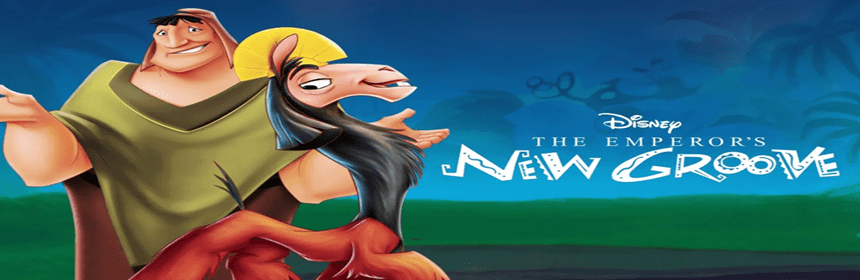
As mentioned in the first blog post in this series, I’ll be writing analysis content on all 60+ Disney animated feature films and their film making eras.
The sixth era is the Post-Renaissance Era, which ran from 1999 to 2008 and started with Fantasia 2000. As mentioned in a previous blog post, the Post-Renaissance Era is known for: its experimentation with both computer-generated (CG) animation (and alternating between traditional hand-drawn and CG animation), and its experimentation with storytelling.
The Post-Renaissance Era is also referred to as Disney’s Second Dark/Bronze Age and Experimental Era.
So how well did The Emperor’s New Groove measure up to these famous features?
Experimentation with computer-generated (CG) animation (and alternating between traditional hand-drawn and CG animation):
According to the film’s IMDb page, this film does not feature any computer animation, which didn’t surprise me, as it was 2D animated and looked like the films from the previous Era. This film and its predecessor are the first example of Disney alternating between traditional hand-drawn and CG animation in this Era.
The gestures of the voice actors that would naturally arise during recording were used to design and animate the characters. Llamas were also studied by the Animation Team, so they were animated and portrayed accurately.
Experimentation with storytelling:
According to the film’s Wikipedia and IMDb pages, this film was originally planned to have been a dramatic, sweeping Disney musical named “Kingdom of the Sun” to be directed by Roger Allers (of The Lion King fame) and Mark Dindal, with six original songs written by Sting, that was essentially an Incan re-telling of The Prince and the Pauper. However, the movie was overhauled and re-written entirely after poor test screenings, with Allers eventually leaving the production. The film was changed from a dramatic, sweeping musical retelling The Prince and the Pauper, to the action-adventure, wacky comedy with an original story that we have today.
The most obvious experimentation with storytelling in this film is via being meta and breaking the fourth wall. The most prolific examples of this are Kuzco acting as the film’s narrator (going as far as “stopping the film” to talk to the audience, and interacting with himself onscreen as if Kuzco the narrator and Kuzco the character are two different people), and the film joking about its own plot hole of Kronk and Yzma making it back to the lab before Kuzco and Pacha, by having Kronk point out it makes no sense and then Yzma immediately moving on from it.
Other minor examples of experimentation with storytelling in the film are the inclusion of modern references and items (like the diner, the squirrel using a balloon to wake up the jaguars, and Tipo using a floor buffer to trip Yzma).
My overall thoughts:
“Breaking away from the semi-serious, and usually musical, nature of most of Disney’s similar films, The Emperor’s New Groove, threw the rules out the window and went completely bonkers, never once stopping to take itself too seriously.” (Disney Canon Countdown: The Post-Renaissance Era, Rotoscopers)
The first time I came across this film was not by seeing it when it came out, but through its PlayStation One game a couple of years after the film’s release. I didn’t see the film for the first time until approximately 2003. Because of the fun and associated memories that the game provided me when I was young, this film will always hold a special place in my heart.
As mentioned above, the film doesn’t take itself too seriously and to me that is its major appeal and what makes it stand out amongst its predecessors. It isn’t pretending to be something it’s not, and these qualities make it a fun and easy watch.
The next part of the Disney Era Analysis series will focus on Atlantis: The Lost Empire
Fun Facts and Trivia (according to the film’s IMDb page):
- Patrick Warburton improvised when Kronk hummed his own theme song when he was carrying Kuzco in the bag to the waterfall. Disney’s legal department had Warburton sign all rights to the humming composition over to them.
- Pacha’s wife, Chicha, is pregnant. According to the DVD commentary, this is the first Disney animated feature film to show a pregnant woman, and one of the first human mothers not to be villainised or killed.
- Three of the animals that Kuzco turns into (llama, parrot, whale) are seen as toys in the scene when he was a baby.
- In the scene where Pacha is carrying Kuzco through the jungle, Pacha and Kuzco discuss Kuzco having low blood sugar. This is an in-joke about the fact that David Spade, who plays Kuzco, suffers from low blood sugar in real life.
- When the plank pieces of the bridges fall in the river, the four letters of the word ‘damn’ can be seen falling one by one amongst the individual planks.
- The first shot of teen Kuzco shows him combing his hair with a bejewelled llama comb.
- Although it’s supposed to be a secret, nearly all of the major characters in the film know about Yzma’s lab.
- In the diner, the saltshakers on the table are shaped like llamas.
- When the paper skull on the potion vial is shown to be a folded llama label, Kronk suggests that Yzma should relabel her vials. In the lab scene, many potions are relabelled in stone on the shelf, but the vials themselves are blank, adding to the confusion during the scuffle.
References:
 Loveday Writing