Disney Era Analysis – Fantasia 2000
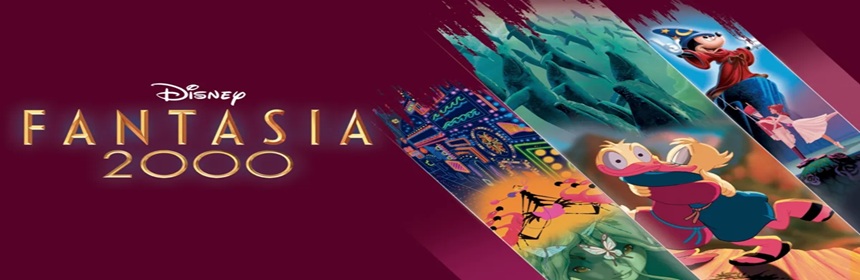
As mentioned in the first blog post in this series, I’ll be writing analysis content on all 60+ Disney animated feature films and their film making eras.
The sixth era is the Post-Renaissance Era, which ran from 1999 to 2008 and started with Fantasia 2000. As mentioned in a previous blog post, the Post-Renaissance Era is known for: its experimentation with both computer-generated (CG) animation (and alternating between traditional hand-drawn and CG animation), and its experimentation with storytelling.
The Post-Renaissance Era is also referred to as Disney’s Second Dark/Bronze Age and Experimental Era.
So how well did Fantasia 2000 measure up to these famous features, and was it the right film to kick of the Era?
Fantasia 2000 is an outlier:
For this analysis, it’s important to point out that Fantasia 2000 is the outlier of this Era. Fantasia 2000 is an anthological film, rather than a film with a plot, and consists of eight animated segments set to pieces of classical music:
- Symphony No. 5
- Pines of Rome
- Rhapsody in Blue
- Piano Concerto No. 2, Allegro, Opus 102
- The Carnival of Animals (Le Carnival des Animaux), Finale
- The Sorcerer’s Apprentice (Reprise)
- Pomp & Circumstance – Marches 1, 2, 3 and 4
- The Firebird Suite (1919 Version)
The music is played/performed by the Chicago Symphony Orchestra, conducted by James Levine, and rather than one Master of Ceremonies like its predecessor, each segment is individually introduced by numerous celebrities.
Not only is Fantasia 2000 an outlier due to its anthological structure, but it is also an outlier due to being a sequel of a film from a previous Disney Era.
Experimentation with computer-generated (CG) animation (and alternating between traditional hand-drawn and CG animation):
Each of the eight segments showcases experimentation with CG animation (and alternating between traditional hand-drawn and CG animation) in the following ways:
- Symphony No. 5 – In this segment, hand-drawn backgrounds using pastels and paint were scanned into the CAP System, with CG abstract shapes and effects layered on top.
- Pines of Rome – The first-third of the segment was hand-drawn using pencil to get a feel of how the whales would move, due to CGI (computer-generated imagery) being in its infancy during the segment’s development. The drawings were then scanned into the CAP System. The CGI code for the water was written from scratch, as hand-drawn animation of the water would have been too-time consuming. The same technique used to animate the stampede scene in The Lion King was used to animate the movements of the whale pod.
- Rhapsody in Blue – This segment was inspired by the work of caricaturist, Al Hirschfield, and reflecting the segment’s title, the colour palette is predominantly blue, with splashes of other colours like red and yellow used sparingly. The segment beginning with the setting being drawn as George Gershwin’s 1924 jazz concerto kicks off, reminded me of All the Cats Join In, a segment from Make Mine Music, a film that has been regarded as the “Wartime Era’s Fantasia”. This segment was traditionally animated.
- Piano Concerto No. 2, Allegro, Opus 102 – This segment marked the first time Disney created main characters entirely from CG animation. The backgrounds were completed via hand-drawn animation. Rain animation from Bambi was scanned into the CAP System and digitally altered to fit into the segment.
- The Carnival of Animals (Le Carnival des Animaux), Finale – This segment was produced with CGI and 6,000 watercolour paintings on heavy bond paper.
- The Sorcerer’s Apprentice (Reprise) – As this was a reprise, it retained its original, traditional animation, from its appearance in this film’s predecessor.
- Pomp & Circumstance – Marches 1, 2, 3 and 4 – This segment contained CGI via the ocean and storm scenes and elements, whereas the characters were hand-drawn.
- The Firebird Suite (1919 Version) – This segment was produced using Houdini animation software with the elk’s antlers produced by CGI.
Experimentation with storytelling:
Each of the eight segments showcase experimentation with storytelling in the following ways:
- Symphony No. 5 – Is an original, abstract story exploring a world of light and darkness.
- Pines of Rome – Is an original story, following a pod of flying humpback whales, with a calf getting lost along the way, but eventually finding their way back to their family. Rather than return to Earth, the pod ends up flying into the stars.
- Rhapsody in Blue – Is an original story, set in New York City during the Great Depression. It follows four individuals having a rough day, whose lives briefly intersect as they yearn for something better. This segment is the longest one of the film.
- Piano Concerto No. 2, Allegro, Opus 102 – Is based on the 1838 fairy tale, The Steadfast Tin Soldier, by Hans Christian Anderson. The ending of the story for this segment was revised to be a happier one, due to the musical piece ending on a high, triumphant note.
- The Carnival of Animals (Le Carnival des Animaux), Finale – Is an original story that was initially going to be a sequel to the Dance of the Hours segment in its predecessor, however the ostriches were changed to flamingos, as they would be fresh, new characters that would be more vibrant onscreen. It is the shortest segment of the film and is set to the “finale” of Camille Saint-Saens’ musical suite.
- The Sorcerer’s Apprentice (Reprise) – This is a reprise of the original segment that was in the predecessor. Despite many attempts to have other segments be sequels to segments in the predecessor film, or to even bring back segments from the predecessor film itself, this is ultimately the only one that carried over.
- Pomp & Circumstance – Marches 1, 2, 3 and 4 – Is based on Noah’s Ark, with Donald Duck playing the role of Noah’s first mate and is set to Sir Edward Elgar’s Pomp and Circumstance. The original concept for the segment was a graduation-style procession of every Disney Prince and Princess being presented with their future children, with an alternate version showing the Prince and Princesses being bequeathed children by storks from Dumbo. Animals from past Disney animated feature films made cameo appearances in this segment.
- The Firebird Suite (1919 Version) – Is an original mythical story of life, death and renewal, with a sprite and elk as its protagonists. The sprite accidentally wakes a fiery spirit of destruction in a volcano who destroys the forest. The elk encourages her to restore the forest to its normal state. The story was inspired by the 1980 eruption of Mount St. Helens. This segment is set to Igor Stravinsky’s The Firebird ballet.
My overall thoughts:
I wrote in my analysis piece on Fantasia, that I was looking forward to watching Fantasia 2000 and seeing how it compares 60 years on. Much like its predecessor, I appreciate Fantasia 2000 as a theatrical masterpiece and would happily see it at theatre.
I read online that the original plan for Fantasia 2000 was to reprise most of the segments from Fantasia and only include a few new segments, but this plan was obviously abandoned in favour of new segments and the reprise of The Sorcerer’s Apprentice. Considering how far Disney had come in the 60 years between films, and how difficult it was to revive Fantasia as the perpetual “work in progress” (described by Steve Martin during this film) that Walt Disney always wanted but never achieved, I feel having mostly new segments was ultimately the right call. I feel that including most of the original segments would be going backwards, not moving forward into the-then fast approaching 21st century.
I personally felt that having different celebrities introduce each segment was a little distracting and over-the-top. I felt that having one Master of Ceremonies like Fantasia did would have been a better call, and would have felt more like a night at the theatre. However, I did appreciate some of the humour present with the celebrities’ introduction to each segment.
I read online that there was a plan for a third Fantasia, Fantasia 2006, however this was ultimately scrapped in 2004 for unknown reasons, with proposed segments for this sequel released as standalone short films. It will be interesting to see if another Fantasia is made in the future, if it is, let’s hope we don’t have to wait another 60 years for it.
Ultimately, having what would turn out to be an outlier film, which paid tribute to the past, showcased how far Disney has come, and provided an insight into the future, with its combination of computer-generated and traditional hand-drawn animation, was a great way to kick off this Era and close out the 20th century for Disney.
The next part of the Disney Era Analysis series will focus on Dinosaur.
Fun Facts and Trivia (according to the film’s IMDb page):
- Then Disney Chairman, Jeffrey Katzenberg, was opposed to the film so development took place without his knowledge or involvement.
- Rhapsody in Blue is the first segment in a Fantasia film to be based on the work of an American composer.
- Pomp and Circumstance has hidden duck shapes throughout it (web foot-shaped puddles, the Ark’s squat hull) to better fit Donald Duck into the picture.
- Pomp and Circumstance never actually shows Noah’s face.
- When Rhapsody in Blue was privately screened for Al Hirschfield and his wife, they were both in tears, due to being overjoyed at seeing Hirschfield’s iconic drawings rendered onscreen.
- Two composers feature in both Fantasia films with different works: Ludwig Van Beethoven (Symphony No. 5 and No. 6) and Igor Stravinsky (The Rite of Spring and The Firebird Suite)
References:
 Loveday Writing