Disney Era Analysis – Dinosaur
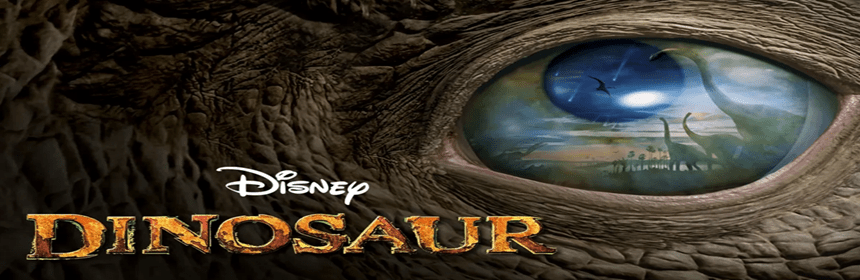
As mentioned in the first blog post in this series, I’ll be writing analysis content on all 60+ Disney animated feature films and their film making eras.
The sixth era is the Post-Renaissance Era, which ran from 1999 to 2008 and started with Fantasia 2000. As mentioned in a previous blog post, the Post-Renaissance Era is known for: its experimentation with both computer-generated (CG) animation (and alternating between traditional hand-drawn and CG animation), and its experimentation with storytelling.
The Post-Renaissance Era is also referred to as Disney’s Second Dark/Bronze Age and Experimental Era.
So how well did Dinosaur measure up to these famous features?
Experimentation with computer-generated (CG) animation (and alternating between traditional hand-drawn and CG animation):
Dinosaur is Disney’s first film to be fully 3D and computer animated, instead of traditionally hand-drawn animated.
According to the film’s IMDb page, the backgrounds in the movie are actually superimposed photos of exotic tropical locations in Venezuela, California, Florida, Hawaii, Australia, Jordan, and Samoa.
Also, according to the film’s IMDb page, to ensure realistic CG animation, 3D workbooks were created using Softimage 3D software, with 48 animators working on the film using 300 computer processors to animate the film. One of the animators, David Krentz, aspired to be a palaeontologist and supervised the character design and visual development teams. Krentz had an orthographic view of the dinosaurs, and his character designs were drawn on paper and scanned into the PowerAnimator software for the modellers to rig in the computers.
In regard to character animation, the dinosaur characters were first visualised in the computer in skeletal form, then rough animations were transferred into three software programs to strengthen the visuals. The three programs were “Fur Tool” (used for the lemurs, and to create feathers and grass), “Body Builder” (used to create skin and muscles for the dinosaurs), and “Mug Shot” (used as a shape blender for facial animation and lip synching).
Visual effects supervisor, Neil Krepela, invented the “Dino Cam”, a camera that was rigged on a cable suspended between two, 72-foot towers. The computer-controlled camera allowed for panning and tilting 360 degrees, and moved at a speed of up to 30 miles per hour across 1,000 feet.
Experimentation with storytelling:
According to the film’s Wikipedia page, the idea for the film’s plot was conceived in 1986 by Phil Tippett and Paul Verhoeven.
Paul Verhoeven described his idea for the film further, specifically the ending, by stating the following:
“The reason why I wanted to do it (the film) was because it had this cosmic vision about evolution. That sounds a bit over the top, but it would have been really good…There was a gigantic battle at the end as a comet moves closer and closer to Earth. The fight was between the sympathetic Styracosaurus and the antagonist Tyrannosaurus rex, and although the good guy wins, there’s nothing to win any more because the comet hits Earth, and all the dinosaurs die. The lemurs survive because they are small enough to hibernate. The end of the film was the beginning of the human race.”
Also according to the film’s Wikipedia page, Tippett and Verhoeven conceived the film as a darker, naturalistic, and more documentary-like film, which tracks as the beginning of the film felt more like a documentary to me.
An interesting observation I made of the film’s plot was its similarities to Tarzan – Aladar is adopted by a family outside of his species and eventually meets others and a love interest of his species, with the main difference being immediate acceptance by his adopted family, specifically a father, or rather grandfather figure.
My overall thoughts:
I have to admit, I did have some negative bias towards this film, due to first interacting with it via the PlayStation One game, which I found boring and difficult, as well as the criticism I heard about it. However, I ended up enjoying the film more than I thought I would.
This film immediately moves away from the cozy, traditional 2D animation from the previous Era and century, and into the 21st century and future with its computer-generated and 3D animation, as well as more mature themes.
On smaller notes, I appreciated Aladar’s immediate friendships formed with the older dinosaurs, and the full circle ending of the film with the eggs in the nest.
The next part of the Disney Era Analysis series will focus on The Emperor’s New Groove.
Fun Facts and Trivia (according to the film’s IMDb page):
- At an official $130 million (unofficially $200 million), this is the most expensive film released in 2000.
- This film has the highest death toll of any animated Disney film.
- This is the fourth Disney animated feature film to not feature any humans.
- No rubbers or prosthetics were used to make the dinosaurs.
 Loveday Writing