Disney Era Analysis – Tarzan
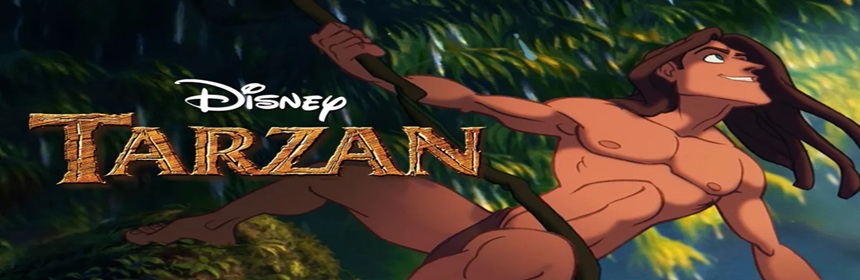
As mentioned in the first blog post in this series, I’ll be writing analysis content on all 60+ Disney animated feature films and their film making eras.
The fifth era is the Renaissance Era, which ran from 1989 to 1999 and started with The Little Mermaid. As mentioned in a previous blog post, the Renaissance Era is known for: the implementation of a Broadway music style, a return to telling legends and fairytales (and bringing back the Disney Princess), brighter and friendlier stories with an emphasis on underdogs on a path to self-discovery, films with more epic scope and scale, and the expansion of computer-generated animation via the introduction of 3D animation and the CAP system.
The Renaissance Era is widely considered Disney’s most successful Era.
So how well did Tarzan measure up to these famous features and was it the right film to end the Era?
Implementation of a Broadway music style:
Although this film is categorised as a “music adventure comedy-drama” and contained a solid soundtrack that acted as the film’s narrator, this film wasn’t a musical, let alone Broadway-like. In fact, Disney made a deliberate effort to move away from the Broadway music style formula, mainly by hiring Phil Collins to provide the film’s soundtrack.
According to the film’s IMDb page, this film and The Rescuers Down Under are the only films in this Era to not be presented as traditional animated musicals.
A return to telling legends and fairytales (and bringing back the Disney Princess):
This film is an adaptation of the 1912 novel by Edgar Rice Burroughs, and due to this and the film’s obvious male lead, there was no Disney Princess in this film.
Brighter and friendlier stories with an emphasis on underdogs on a path to self-discovery:
This film’s story contained mature themes and darker moments, such as the hunting motif in the form of Clayton, and the attacks by him and Sabor on Tarzan and the gorillas. However, the humour present through Tarzan’s interactions with Jane and her father which provided the film with bright and friendly moments.
Tarzan is definitely an underdog on a path to self-discovery as a human (when he meets Jane and her father), and with his found gorilla family, especially as he has to juggle both paths of self-discovery once he meets humans for the first time.
Films with more epic scope and scale:
The film’s jungle setting provided epic scope and scale, which was on show especially during the scenes involving Tarzan swinging through and sliding on the trees, as well as when Sabor is chasing Tarzan. Scale is also shown in the ratios between the size of the humans in comparison to the gorillas.
The expansion of computer-generated animation via the introduction of 3D animation and the CAP system:
The expansion of computer-generated animation via 3D animation was used in this film by creating sweeping 3D backgrounds with 2D characters blended in. This technique came to be known as “Deep Canvas” and allows artists to produce CGI backgrounds that look like a traditional painting. I believe this technique was what made the film look sharper, almost realistic, geometric, and why it felt more digital than storybook in its overall design.
According to the film’s IMDb page, one of the main reasons why animation was chosen as the perfect way to execute a Tarzan story was because the character is so lithe and animal-like, it would have been nearly impossible to achieve those effects with live-action film making.
Tarzan bears a resemblance to Beast’s human form from Beauty and the Beast since both of them were animated by Glen Keane.
Some of my favourite animation moments included Tarzan sliding through the trees (which was based on the movements of pro skateboarder, Tony Hawk).
My overall thoughts:
Overall, I did struggle to engage with this film initially, feeling it was more slow-paced, however I did become more engaged with it as it progressed, specifically after Tarzan meets Jane and the other humans. I appreciated a lot of the full circle moments that were written in, such as Tarzan discovering another human and his differences with his found family via his hands, Tarzan killing Sabor (after Sabor killed his parents and gorilla sibling), and Kala taking Tarzan to his parents’ home to tell him the truth.
This film was the right one to end the Renaissance Era as it was not a traditional animated musical like its predecessors, a trait that would continue on into the next Era, the Post-Renaissance Era, and its Deep Canvas animation technique proved how far Disney had come over the decade with its computer-generated and 3D animation, which would also carry over into the next Era.
It’s also very fitting that this is the last film of the Era with its late 19th to early 20th century setting (alluded to through Tarzan’s parents wardrobe and the appearance of what appears to be Halley’s Comet when Tarzan is an adult, placing the setting in mostly 1910) juxtaposed with its 1999 release, making it the second-last Disney film to be released in the 20th century.
The next part of the Disney Era Analysis series will focus on the Post-Renaissance Era and the first film within that Era, Fantasia 2000.
Fun Facts and Trivia (according to the film’s IMDb page):
- The signature ‘Tarzan yell’ was provided by Brian Blessed (Clayton).
- According to the DVD commentary, Clayton’s outfit was designed to appear like Sabor’s yellow fur to designate him as the new villain. When he’s introduced, he’s covered in shadows that give him the look of spots similar to Sabor’s.
- Minnie Driver largely ad-libbed the breathless speech in which Jane tells her father and Clayton about meeting Tarzan for the first time.
- As lions are not found in jungles, Sabor was changed from a lion to a leopard for this movie, which is the real apex predator of the jungle area depicted.
- The teapot in the camp deliberately resembles Mrs Potts from Beauty and the Beast.
- Tarzan never refers to Kerchak as “father” since he refused to accept Tarzan as his son.
- Even though Tarzan talks throughout the film, he actually only has 42 lines.
References:
 Loveday Writing