Disney Era Analysis – Mulan
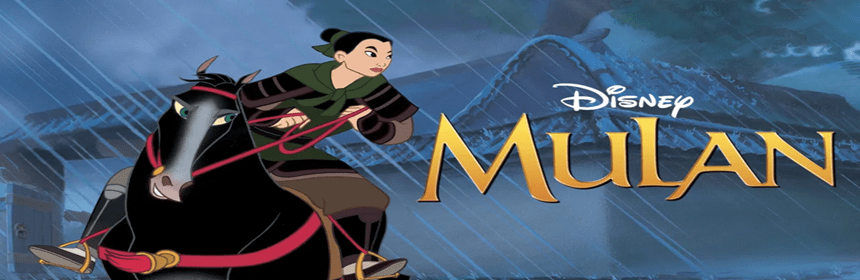
As mentioned in the first blog post in this series, I’ll be writing analysis content on all 60+ Disney animated feature films and their film making eras.
The fifth era is the Renaissance Era, which ran from 1989 to 1999 and started with The Little Mermaid. As mentioned in a previous blog post, the Renaissance Era is known for: the implementation of a Broadway music style, a return to telling legends and fairytales (and bringing back the Disney Princess), brighter and friendlier stories with an emphasis on underdogs on a path to self-discovery, films with more epic scope and scale, and the expansion of computer-generated animation via the introduction of 3D animation and the CAP system.
The Renaissance Era is widely considered Disney’s most successful Era.
So how well did Mulan measure up to these famous features?
Implementation of a Broadway music style:
This film is classified as a musical coming-of-age, action-adventure film.
The film’s IMDb page states that the story acts like a fairly light-hearted musical, focusing on the antics of Mulan and her friends and that halfway through the film, the characters are singing ‘A Girl Worth Fighting For’ and the song ends abruptly, when they reach the destroyed village. Having been shown the devastating reality of war, Mulan and several other characters become more sombre and serious. The film stops being a musical and becomes more dramatic. It becomes a musical again briefly in the third act, which signifies the soldiers’ hope and optimism returning.
A one-act stage musical, Mulan Jr, was adapted from the film and is designed for young performers. A stage musical version also played in Singapore from 2016 to 2017.
A return to telling legends and fairytales (and bringing back the Disney Princess):
This film is based on the Chinese legend of Hua Mulan from the Northern and Southern dynasties era (4th to 6th century AD).
Mulan is one of the official Disney Princesses and with her inclusion came a lot of firsts and rarities for a Disney Princess: the first to be Chinese/East Asian, the first to be based on a legend rather than a fairytale, only one of two who are left-handed, the first not to have a kiss in her film, and the second to have both parents alive and present during the entire film.
Brighter and friendlier stories with an emphasis on underdogs on a path to self-discovery:
Much like its predecessor, this film is filled with comedy and other pop culture references, however it does shift in tone when the characters find the aftermath of the burned village and lost battle. The tone of the film and the film itself shifts from musical comedy to dramatic action-adventure.
Mulan is an underdog on a path to self-discovery, joining the Imperial Army to save her father and becoming a stronger person for it, both physically and mentally. She also seeks for her reflection to reflect who she really is, and it eventually does, despite some self-doubt after her secret is discovered by her fellow soldiers.
Films with more epic scope and scale:
The film’s setting in China in various areas of the country in various seasons of the year, as well as climactic battle scenes in the mountains and the Forbidden City, provides epic scope and scale.
The expansion of computer-generated animation via the introduction of 3D animation and the CAP system:
This film utilised computer-generated animation by using the latest technology to add detail and mimic camera techniques that were previously unavailable in the previous films of the Era, such as the crowd scenes of up to 30,000 people. A few specific examples include using a computer program called “Atilla” to create the sequences of 2,000 Huns on horseback. According to the film’s Wikipedia page, a variant of the program, “Dynasty” was used for the final battle sequence to create a crowd of 3,000 people in the Forbidden City, similarly to The Lion King where a computer program was created for the stampede scene.
According to the film’s IMDb page, Mulan and her father, Fa Zhou, were animated by the same team as it helped make them look related to each other.
My overall thoughts:
Overall, I thoroughly enjoyed this film, and it was even more enjoyable since I hadn’t seen it before. I appreciated that this film was lighter and comedic like its predecessor, but what I appreciated even more is that it pulled off a tone and even genre change in a way that was abrupt but not jarring. Being the second-last film of the Era, it was good to see that its makers took a risk, and it paid off.
The next part of the Disney Era Analysis series will focus on Tarzan.
Fun Facts and Trivia (according to the film’s IMDb page):
- Mulan touches her hair a lot because the animators noticed that Ming-Na Wen did.
- This film marked Disney’s first-ever DVD release, it was released in November 1999.
- Mulan’s name means “wood orchid” or “magnolia”. As such, magnolias serve as a running motif in the film.
- This is the first Disney animated feature film to openly deal with warfare.
- The opening titles were put together by simply putting watercolour on rice paper.
- This is the only Disney animated feature film to use the phrase “cross-dresser”. The film was almost rated PG because of the use of the phrase.
- Mulan is one of only two Disney female characters to wear trousers, with the other being Jasmine from Aladdin.
- This film marked Eddie Murphy’s debut as a voice actor.
- Crickets are considered a symbol of good luck in China, hence the inclusion of one as a character.
- This is the first Disney animated feature film to feature an Asian heroine.
- Along with its direct predecessor (Hercules), this is the second Disney animated feature film to not feature a musical number for the main villain despite featuring musical numbers.
- The Emperor says that a single grain of rice can tip the scale, in the next scene, Mulan balances a single grain of rice in her bowl.
References:
 Loveday Writing