Disney Era Analysis – Hercules
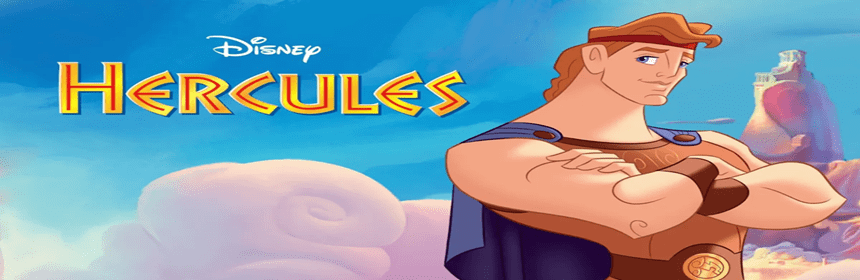
As mentioned in the first blog post in this series, I’ll be writing analysis content on all 60+ Disney animated feature films and their film making eras.
The fifth era is the Renaissance Era, which ran from 1989 to 1999 and started with The Little Mermaid. As mentioned in a previous blog post, the Renaissance Era is known for: the implementation of a Broadway music style, a return to telling legends and fairytales (and bringing back the Disney Princess), brighter and friendlier stories with an emphasis on underdogs on a path to self-discovery, films with more epic scope and scale, and the expansion of computer-generated animation via the introduction of 3D animation and the CAP system.
The Renaissance Era is widely considered Disney’s most successful Era.
So how well did Hercules measure up to these famous features?
Implementation of a Broadway music style:
This film is classified as a “musical fantasy comedy” with heavy Broadway and gospel musical elements and songs. The film was also adapted into a stage musical, with an off-Broadway debut in 2019 and opening on the West End in 2025.
A return to telling legends and fairytales (and bringing back the Disney Princess):
The plot of the film is based on the Greek myth of Heracles. There was no Disney Princess in this film due to its obvious male lead.
According to the film’s IMDb page, this was the first Disney animated feature film to be completely inspired by mythology rather than a fairytale. There are also many references to the Tragedy of Oedipus in the plot. The film was originally intended to be an adaptation of Homer’s Odyssey but this idea was scrapped as it didn’t fit the animated comedy formula Disney had in mind.
The film’s IMDb page also states that the directors decided from the beginning not to use the obvious choice of traditional Greek instrumentation or musical themes, but rather to incorporate pop and gospel influences. Their logic was due to gospel music being exhilarating and being associated with hope, idealism, and larger-than-life things.
Brighter and friendlier stories with an emphasis on underdogs on a path to self-discovery:
According to the film’s IMDb page, this film was released to “lighten things up” after the backlash against its two predecessors, Pocahontas and The Hunchback of Notre Dame, specifically that those two films were “too dark” and dealt with “serious issues” that Disney shouldn’t be addressing in their animated films.
Whilst this film was definitely brighter and more comedic, especially with its integration of Ancient Greek myths and design with contemporary and pop culture references, there were some darker moments. These darker moments include Hercules being kidnapped, Hercules being forced to drink the potion that made him mortal, and Hercules cutting himself free from inside the Hydra.
Hercules was an underdog on a path to self-discovery, especially when he discovered he was a God and subsequently went on to train so he could prove himself to be a true hero on Earth.
Films with more epic scope and scale:
This film’s epic scope and scale was shown during the Hydra battle scene, as well as with its Ancient Greek Earth and heaven-like landscapes.
The expansion of computer-generated animation via the introduction of 3D animation and the CAP system:
The CAP system was put to use when animating the Hydra, specifically its multiple heads. According to the film’s IMDb page, the animators decided that the Hydra would ultimately have 30 heads, creating one master head and having computers multiplying the heads to their desired scale. Overall, 13 animators and technical directors spent around a year-and-a-half creating the four-minute battle sequence involving the Hydra, and it would take six-to-14 hours to render a frame of the Hydra, depending on how many heads it had in each frame.
The film’s IMDb page also states that the rest of the movie is hand-drawn animation, and the Hydra was rendered via computer-generated animation, as it would have been incredibly difficult to draw each head individually.
The film’s IMDb page also states that some of the film’s crew went on a tour of Greece and Turkey for inspiration and research, and much of the film’s style is drawn from Ancient Greek artwork.
My overall thoughts:
Overall, this film’s brighter and comedic tone and nature was welcome after the darkness of its two predecessor films. I appreciated the integration of Ancient Greek myths and nature with contemporary references and themes, as well as the fantastical design of its world. However, I felt that the muses felt out of place by the halfway point of the movie, as the tone change that came with them was uneven and jarring. I also appreciated the “damsel in distress” cliché being modernised by making Meg a strong and sarcastic character.
The next part of the Disney Era Analysis series will focus on Mulan.
Fun Facts and Trivia (according to the film’s IMDb page):
- While the movie is about Greek myths, Hercules is actually the protagonist’s Roman name, Heracles is his Greek name.
- Phil cleans himself up using a lion’s skin. The skin once belonged to Scar from The Lion King.
- In Greek mythology there were nine muses. The five shown in the film are: Calliope (epic poetry), Clio (history), Melpomene (tragedy), Terpsichore (dance) and Thalia (comedy).
- The Spice Girls were originally approached to portray the Muses following an invitation to sing one of the songs but declined the offer due to scheduling conflicts.
- The Hydra is a rare instance of blood and gore shown onscreen in a Disney film, as it visibly bleeds green blood after its heads are cut off.
- Scar makes a cameo in the film as a pelt. This could be a built in-joke from The Lion King as Zazu joked Scar would make a good throw rug.
- Hercules’ credit card number is shown as “VI V XI XIV XV XVI IV, ex IV M BC, member since I M BC” or “6511 14 1516 4, expires Apr 1000 BC, member since Jan 1000 BC.”
- As Meg and Hercules are falling in love in the park, Meg gets poked in the back by Cupid’s arrow.
- Currently, this is the only Disney animated feature film in the 1990s and of the Renaissance Era to not have any sequels, prequels, or midquels (not counting The Rescuers Down Under, as it is a sequel to The Rescuers, a film from the previous Era).
References:
 Loveday Writing