Disney Era Analysis – The Hunchback of Notre Dame
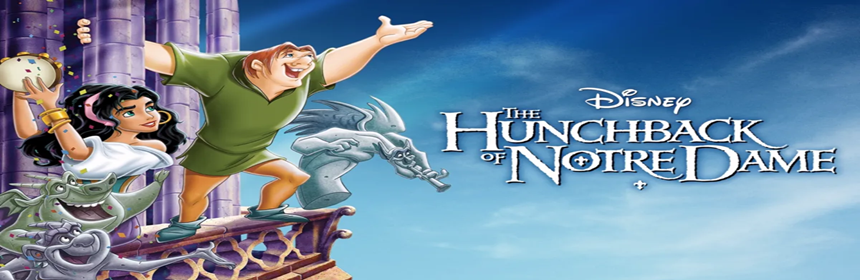
As mentioned in the first blog post in this series, I’ll be writing analysis content on all 60+ Disney animated feature films and their film making eras.
The fifth era is the Renaissance Era, which ran from 1989 to 1999 and started with The Little Mermaid. As mentioned in a previous blog post, the Renaissance Era is known for: the implementation of a Broadway music style, a return to telling legends and fairytales (and bringing back the Disney Princess), brighter and friendlier stories with an emphasis on underdogs on a path to self-discovery, films with more epic scope and scale, and the expansion of computer-generated animation via the introduction of 3D animation and the CAP system.
The Renaissance Era is widely considered Disney’s most successful Era.
So how well did The Hunchback of Notre Dame measure up to these famous features?
Implementation of a Broadway music style:
This film contains many musical numbers and was adapted into a stage musical, premiering in Berlin in 1999. However, it was not adapted into a Broadway musical. This film is also classified as a medieval period musical.
Interestingly, according to the film’s IMDb page, this film is Disney’s last animated feature film with musical numbers to feature a musical number for its main antagonist up until The Princess and the Frog.
A return to telling legends and fairytales (and bringing back the Disney Princess):
This film is an adaptation of the 1831 novel of the same name by Victor Hugo. This film didn’t contain an official Disney Princess.
Brighter and friendlier stories with an emphasis on underdogs on a path to self-discovery:
This film’s story is not bright or friendly by any means, in fact, this film is known for consisting of dark and sexual themes (and I personally felt it was too dark for a “kid’s film”). However, the film did have its humorous moments, with the gargoyles providing much needed comic relief throughout.
According to the film’s IMDb page, Frollo is considered one of the darkest and most evil Disney villains, and this was a deliberate choice by Disney as an attempt to avert the “evil is cool” trope. The IMDb page also stated that the song “Hellfire” is considered one of the darkest songs written for a Disney film.
Quasimodo was definitely an underdog on a path to self-discovery, specifically a path to self-acceptance, as well as being accepted by society.
Films with more epic scope and scale:
The film’s Parisian and Notre Dame setting provide epic scope and scale, specifically the inside of Notre Dame and the bell tower.
The expansion of computer-generated animation via the introduction of 3D animation and the CAP system:
According to the film’s IMDb page, to stay consistent to the architecture and details of Notre Dame, animators spent several weeks in and around the actual cathedral. They were even given office space at Disneyland Paris.
According to the film’s Wikipedia page, the software program, Crowd, was created for large-scale crowds to be animated, with the program’s creation also inspired by the animation of the wildebeest stampede in The Lion King.
In regard to the film’s use of the CAP system, this film mainly took more advantage of the system’s 2D and 3D integration. The film is also filled with 3D rendered and computer-generated animation, including but not limited to: the bells in the bell tower, Quasimodo sliding down the buttress, the confetti and the crowds of people, the reflection of the Notre Dame’s rose window, and the background flames during the “Hellfire” musical number. The multiplane effect that the CAP system is known for was also used, when the camera pans over Paris and through Parisian buildings.
My personal favourite animation moments included: Quasimodo swinging through the bell tower, Esmeralda in front of the rose window, and the animation of the gargoyles moving around with the sound of stone being heard as they moved. One animation moment that I found interesting was that of the skeletons at the Court of Miracles, as it reminded me of the animation of a similar scene in The Black Cauldron.
My overall thoughts:
Overall, I felt that this film was the darkest of the Era so far. This film was the first and apparently, currently only Disney animated feature film to have a major focus on traditional religious faith, and I believe that the use of faith in positive (as a sanctuary for Quasimodo and Esmeralda) and negative ways (to mentally torture Quasimodo and bait the villagers), mainly negative ways, was a major contributing factor in the film’s dark nature. I also felt that this film was the darkest of the Era due to its strong adult themes of prejudice, acceptance, sin, morality, mental health (specifically the ambiguity of whether the gargoyles were alive or not) and love.
I personally felt that this film was too dark and too adult to be classified as a “kid’s film”, with the scene of Quasimodo being humiliated by the villagers particularly hard to watch. However, I felt that the film was more engaging to me personally than The Rescuers Down Under and Pocahontas.
The next part of the Disney Era Analysis series will focus on Hercules.
Fun Facts and Trivia (according to the film’s IMDb page):
- The film takes place in 1482 and 1502.
- Although the Archdeacon was the one who originally saved Quasimodo’s life, the two are never actually seen together.
- This is the Disney animated feature film featuring the fewest number of trees.
- Phoebus is the first Disney hero to sport facial hair.
- Although Quasimodo is the fourth Disney character to be raised by a villain, he is the only one to not have a royal background.
References:
 Loveday Writing