Disney Era Analysis – Pocahontas
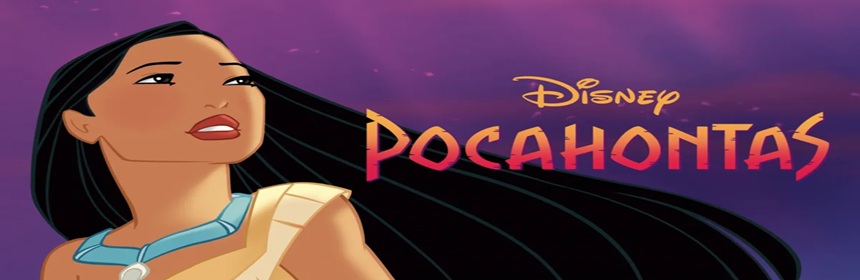
As mentioned in the first blog post in this series, I’ll be writing analysis content on all 60+ Disney animated feature films and their film making eras.
The fifth era is the Renaissance Era, which ran from 1989 to 1999 and started with The Little Mermaid. As mentioned in a previous blog post, the Renaissance Era is known for: the implementation of a Broadway music style, a return to telling legends and fairytales (and bringing back the Disney Princess), brighter and friendlier stories with an emphasis on underdogs on a path to self-discovery, films with more epic scope and scale, and the expansion of computer-generated animation via the introduction of 3D animation and the CAP system.
The Renaissance Era is widely considered Disney’s most successful Era.
So how well did Pocahontas measure up to these famous features?
Implementation of a Broadway music style:
Pocahontas is classified as an animated musical historical drama film and consists of many musical numbers. However, this film was not adapted into a Broadway musical, like some of the predecessor films of this Era.
According to the film’s IMDb page, this film didn’t feature a show-stopping musical number like its predecessors, as the story didn’t really lend itself to such an ornate production number.
A return to telling legends and fairytales (and bringing back the Disney Princess):
This film is loosely based on the life of Powhatan woman, Pocahontas, and the arrival of English settlers from the Virginia Company.
Pocahontas is an official Disney Princess, and her status as one came with a lot of firsts: the first to be born in America, the first not to be based on fairytale or folklore but a historical figure, and the first that is technically not a princess in her film (not born into or married to royalty). She is also the only one to wear one outfit throughout their entire film, as well as only one of two to have a visible tattoo. `
Brighter and friendlier stories with an emphasis on underdogs on a path to self-discovery:
Due to its historical basis and the seriousness of the topics it addresses, this film really isn’t a bright and friendly story. However, it does have humorous elements, specifically with the interactions between Meeko, Flit and Percy. Towards the end of the film, the conflict between the Native Americans and the English Settlers ends on a mutually peaceful note (bar the Governor trying to shoot Chief Powhatan and hitting John instead).
In all honesty, I don’t think there is really an individual underdog on a path to self-discovery. However, you could say the romance between Pocahontas and John is a form of an underdog, as their relationship has them discover the differences between their cultures and ultimately leads to them ending the conflict between the Native Americans and English Settlers.
Films with more epic scope and scale:
The film’s wooded clearing, Virginian setting provides epic scope and scale, specifically deep into the woods and water-based areas. The English Settlers’ ship also provides scale, a giant amongst the wooded clearing and wilderness.
The expansion of computer-generated animation via the introduction of 3D animation and the CAP system:
According to the film’s IMDb page, animators working on the film regarded it as being one of the hardest films ever produced by Disney. This was due to the complex colour schemes, angular shapes, and facial expressions causing the movie to be production in for five years. Their hard work paid off as the character of Pocahontas has been cited as one of the most beautifully and realistically animated Disney characters.
Rotoscoping was heavily used, specifically for the physical models and movements of the characters. Irene Bedard (Pocahontas) and Mel Gibson (John Smith) were the physical models for their respective characters. Christian Bale (Thomas) was sketched by the animators so they could base Thomas’ movements on his own.
This film was Disney’s first animated feature film to be released in Dolby Digital.
This film’s animation style stood out to me as it felt different to its predecessors in this Era. The design of the English Settlers felt harsher and sharper, more squarish, in comparison to the Native American characters. According to the film’s IMDb page, the animation style of the film is of a more flat and geometric appearance. My favourite animation moments were: Pocahontas and Nakoma in the water under the canoe, the scenes involving the waterfalls, the animation of the willow leaves in the wind, and the animation of the smoke and depiction of the English Settlers during the council meeting.
According to the film’s Wikipedia page, a 3D software program was used on the animation of Grandmother Willow, specifically so the bark could be individually manipulated and for the face to match with the computer-generated texture of the tree.
My overall thoughts:
Overall, this was a good quality film but not as great quality as some of the previous films in the Era. I appreciated that this film took a different approach by focusing on a historical figure, instead of one from folklore or a fairytale.
Whilst this film had strong musical numbers, I didn’t feel they were as “Broadway” as the music of the previous films. I also felt that the film started off on a fast pace, almost a little too fast, only to slow down. I didn’t hate the pace change, but it was a little jarring. However, I appreciated that the film’s ending was hopeful, bittersweet, sad, but realistic.
One thing I found interesting was the film’s IMDb page stating that as the film dealt with more adult themes and tones, it didn’t appeal to younger children. I feel that this is why this film felt different to me and was not as of great quality, and whilst I appreciate Disney’s efforts to be as authentic as possible behind the scenes, I can see why it was criticised for its historical accuracy and some of the creative licence that was used. Whilst we see that Pocahontas is a free spirit and strong woman, I don’t feel that we truly got to know her on a meaningful level, we only got to know her through her experiences with John.
The next part of the Disney Era Analysis series will focus on The Hunchback of Notre Dame.
Fun Facts and Trivia (according to the film’s IMDb page):
- The film’s release on June 23, 1995, was also the 400th anniversary of the real Pocahontas’ birth.
- This is Disney’s first animated feature film to have an interracial romance.
- This is the first film to feature Mel Gibson singing.
- This is the first animated Disney feature film to have a Native American protagonist.
References:
 Loveday Writing