Disney Era Analysis – The Lion King
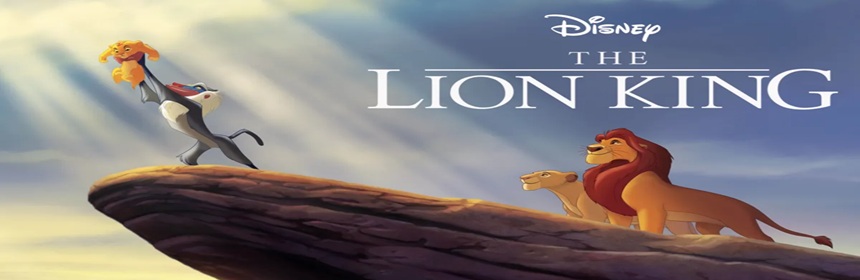
As mentioned in the first blog post in this series, I’ll be writing analysis content on all 60+ Disney animated feature films and their film making eras.
The fifth era is the Renaissance Era, which ran from 1989 to 1999 and started with The Little Mermaid. As mentioned in a previous blog post, the Renaissance Era is known for: the implementation of a Broadway music style, a return to telling legends and fairytales (and bringing back the Disney Princess), brighter and friendlier stories with an emphasis on underdogs on a path to self-discovery, films with more epic scope and scale, and the expansion of computer-generated animation via the introduction of 3D animation and the CAP system.
The Renaissance Era is widely considered Disney’s most successful Era.
So how well did The Lion King measure up to these famous features, and was it the right film to mark the halfway point of the Era?
Implementation of a Broadway music style:
This film is classified as a musical drama film, and like its predecessor, it starts with a musical number instead of dialogue. Its soundtrack went on to become the best-selling soundtrack album to an animated film in the United States.
This film was also adapted into a Broadway musical, making its debut in 1997. It is still running to this day, making it one of the longest-running and most popular musicals, garnering six Tony Awards.
A return to telling legends and fairytales (and bringing back the Disney Princess):
Interestingly, this is the only film of the Era to tell an original story. However, it is inspired by many legendary works of literature, including but not limited to: Hamlet, the Osirian family myths of Ancient Egyptian mythology, Sundiata: An Epic of Old Mali, and Bambi. It also copied some elements fromthe Biblical stories of Cain and Abel, and Moses and Joseph.
According to the film’s IMDb page, when writer, Irene Mecchi, came on board, she was told that the film’s story pitch was “Bambi in Africa meets Hamlet”, or “Bamlet.”
There was no Disney Princess in this film.
Brighter and friendlier stories with an emphasis on underdogs on a path to self-discovery:
For the most part, this film is incredibly dark, obviously so as it contains a murder, as well as the consequences of the murder of a king when Scars takes over. In fact, according to the film’s IMDb page, the film had even darker scenes, themes and an even an ending, but they were omitted or changed. However, it does have happier and humorous elements, once Timon and Pumbaa are introduced.
Simba is the underdog on a path to self-discovery once he and Nala reunite and she informs him about the state of the Pride Lands since he left and Scar took over. Despite his doubts and fears, Simba eventually defeats Scar and takes his place as king.
Films with more epic scope and scale:
The film’s African setting provides epic scope and scale, providing many different types of environments: a barren desert, an oasis, and lush Pride Lands, simultaneously. According to the film’s IMDb page, several Disney animators went to Africa to study animal behaviour and interactions in the wild.
According to the film’s IMDb page, the main locations for the film, such as Pride Rock and the Gorge, are modelled after Hell’s Gate National Park in Kenya. According to the film’s Wikipedia page, the epic and vast feel of the film can be attributed to the animators and artists trying to depict the effects of painters, as they wanted the audience to feel like they were in the savannah as they were watching the film.
The expansion of computer-generated animation via the introduction of 3D animation and the CAP system:
According to the film’s Wikipedia page, the CAP system helped simulate camera movements such as tracking shots, and was employed in colouring, lighting, and particle effects.
According to the film’s IMDb page, the wildebeest stampede took Disney’s computer graphics department approximately three years to animate, as a new computer program had to be written for the stampede that allowed hundreds of computer-generated animals to run but without colliding into each other.
The animators and artists also studied real-life animals for reference, and a wildlife expert visited the studio on several occasions to discuss animal behaviour, and assist the animators and artists give their work an authentic feel.
According to the film’s IMDb page, more than 600 animators, artists and technicians worked on the film.
For me personally, I appreciated that the colour scheme changes and that the animation becomes more exaggerated during the musical numbers. My favourite animation moment was the scene where Rafiki helps Simba, and Simba sees Mufasa in his own reflection in the water.
My overall thoughts:
Full disclosure, I’ve already seen this film before, over a decade ago. I enjoyed it then and I enjoyed it again when I watched it for this Analysis series.
I personally feel that this was the right film to mark the halfway point of the Era as it was easily the most successful and renowned film of the Era, which makes me appreciate the irony of most of Disney’s crew thinking it wouldn’t be as successful as its successor, Pocahontas.
I appreciated that this film felt like an epic musical in its structure, themes and musical numbers, as well as the fact that it made small modern references and had at least one fourth wall break.
This film was definitely the Renaissance Era at its peak.
The next part of the Disney Era Analysis series will focus on Pocahontas.
Fun Facts and Trivia (according to the film’s IMDb page):
- This film’s video was the best-selling home video of all time, with more than 55 million copies sold to date.
- Unlike the other lions, Scar’s claws are always displayed throughout the film.
- This film is the first Disney film to be dubbed into Zulu for its African release.
- Adult Simba’s mane was supposedly inspired by Jon Bon Jovi’s hair.
- Pumbaa the Warthog was the first character in Disney films to exhibit flatulence.
- Simba is the first animated Disney character to have a villain as a biological relative.
- This is the first Disney animated feature film to not feature any humans, after Bambi and Robin Hood. It is also the only film in the Era to not feature any humans.
- This film is the highest grossing traditionally animated film of all time.
- The song, “I Can’t Wait to be King” has a sad irony to it as Simba sings it the day before Mufasa dies, making Simba the official king of the Pride Lands.
References:
 Loveday Writing