Disney Era Analysis – Aladdin
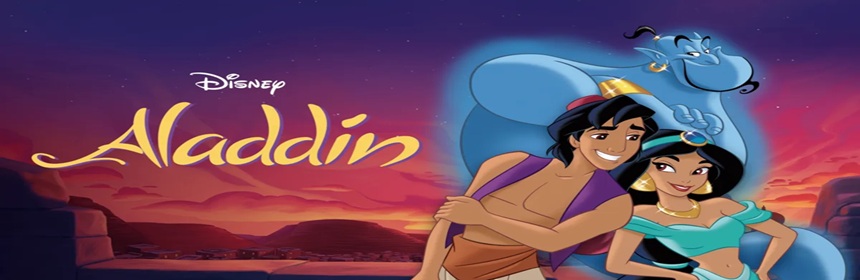
As mentioned in the first blog post in this series, I’ll be writing analysis content on all 60+ Disney animated feature films and their film making eras.
The fifth era is the Renaissance Era, which ran from 1989 to 1999 and started with The Little Mermaid. As mentioned in a previous blog post, the Renaissance Era is known for: the implementation of a Broadway music style, a return to telling legends and fairytales (and bringing back the Disney Princess), brighter and friendlier stories with an emphasis on underdogs on a path to self-discovery, films with more epic scope and scale, and the expansion of computer-generated animation via the introduction of 3D animation and the CAP system.
The Renaissance Era is widely considered Disney’s most successful Era.
So how well did Aladdin measure up to these famous features?
Implementation of a Broadway music style:
Aladdin is classified as a musical fantasy film and starts with a musical number instead of dialogue.
Aladdin was adapted into a Broadway musical in 2011, with some songs that were cut from the film making it into the Broadway adaptation. Jonathan Freeman, who voiced Jafar, ended up reprising his role in the Broadway musical and portraying it until 2022, making him the only performer to play the same role in both the film and Broadway adaptation of a Disney plot.
A return to telling legends and fairytales (and bringing back the Disney Princess):
This film is based on the folktale, “Aladdin”, from One Thousand and One Nights, a collection of Middle Eastern folktales compiled in Arabic during the Islamic Golden Age. Some of the film’s plot elements are also similar to the plot of The Count of Monte Cristo.
Jasmine is one of the official Disney Princesses, as well as the princess in the film’s plot. Jasmine is the first Middle Eastern Disney Princess, as well as the first one to kiss a villain.
Brighter and friendlier stories with an emphasis on underdogs on a path to self-discovery:
Whilst this another film of the Era with dark themes present, such as slavery and forced marriage, the film’s humour and colour scheme make it brighter and friendlier.
Like it’s predecessor, both of the film’s main characters were underdogs for different reasons – Aladdin for aspiring to be more than a “street rat” and actually being labelled a ‘diamond in the rough’ by the Cave of Wonders, whilst Jasmine was an underdog in her efforts to live her life beyond the palace walls, and her unsurprising naivety at the markets. Aladdin’s underdog/diamond in the rough nature is the foundation that the film’s events is built on.
Films with more epic scope and scale:
The film’s Middle Eastern desert setting provided scope and scale, especially with the scenes involving the magic carpet ride. The palace also provide some scope, especially when you look at the scale of the characters in comparison to the palace’s walls and gardens.
Genie’s mostly unlimited powers and how he uses them alongside his zany personality also provide scope to the film. The Cave of Wonders, and its size and abilities also provide scope, adding another layer of mysticism and magic.
The expansion of computer-generated animation via the introduction of 3D animation and the CAP system:
According to the film’s IMDb page, this was the second Disney animated feature film to use fully rendered and textured 3D computer-generated moving backgrounds, in combination with the traditionally animated character animation. This technique led to the creation of “Deep Canvas”, a brand new technique created by Disney seven years later for use in Tarzan, which allows 2D hand-drawn characters to exist seamlessly in a fully 3D environment.
According to the film’s IMDb page, production designer, Richard Vander Wende, devised a simple colour scheme for the film, inspired by its desert setting. Blue (water) stands for good, red (heat) for evil, and yellow (sand) for neutral. This was obvious to me as I watched the film, especially the red, as nearly every scene involving Jafar has him dressed in and surrounded by red. Jafar being surrounded by red is similar to Beauty and the Beast’s Gaston being surrounded by red to emphasise his villainy.
My personal favourite animation moments in this film were how shiny the lamp was at the beginning of the film, Jasmine’s and the Sultan’s reflections in water, and some of the market scenes that reminded me of Looney Tunes-like animation.
My overall thoughts:
Much like this film’s predecessor, I have also seen this film before. I enjoyed it when I saw it for the first time and I enjoyed watching it again for this analysis blog post.
I felt that Aladdin was more personal and modern than this Era’s predecessors, mostly due to Robin William’s casting and constant improv, as the Genie constantly impersonated influential figures in the real world at the time, and made multiple cultural references to the real world. The film also breaks the fourth wall on multiple occasions, something that the previous films of the Era didn’t do.
I also appreciated that this film was more visually vibrant, as well as more humorous and playful than its predecessors.
The next part of the Disney Era Analysis series will focus on The Lion King.
Fun Facts and Trivia (according to the film’s IMDb page):
- Whenever Aladdin tells a lie, the big purple feather on his turban falls and covers his face.
- Aladdin’s monkey, Abu, was named after the ancient Egyptian city of Abu. This translates to elephant, because the city was known for its trade in ivory. Therefore, it is not surprising that when enchanted, Abu shift shapes into an elephant.
- While the frame story, One Thousand and One Nights, is set in the Middle East, the original “Aladdin” was actually set in China.
- One of the few Disney animated feature films to fully establish the villain before introducing the protagonist.
- Aladdin was the very first film to receive an Icelandic dub.
- The Genie doesn’t appear onscreen until nearly 36 minutes in.
- The film was originally supposed to be set in Baghdad, but the setting was changed to a fictional city, due to the Middle East political climate at the time.
- Robin Williams was quite nervous about singing, something he had rarely done in films. To make him feel more at ease, he was encouraged to sing in whatever accent he chose.
References:
- https://en.wikipedia.org/wiki/Aladdin_(1992_Disney_film)
- https://www.imdb.com/title/tt0103639/trivia/?ref_=tt_dyk_trv
- https://en.wikipedia.org/wiki/Aladdin_(2011_musical)
- https://en.wikipedia.org/wiki/One_Thousand_and_One_Nights
- https://en.wikipedia.org/wiki/Disney_Renaissance
- https://en.wikipedia.org/wiki/Disney_Princess
 Loveday Writing