Disney Era Analysis – Beauty and the Beast
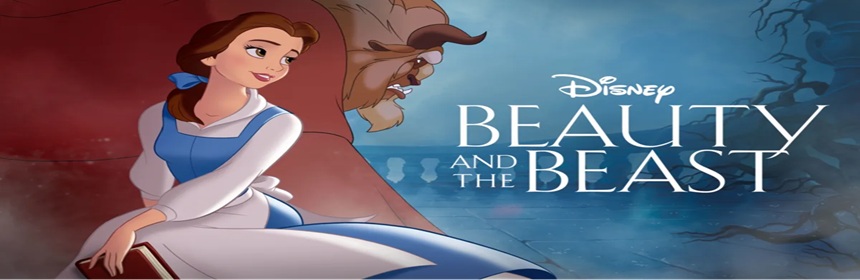
As mentioned in the first blog post in this series, I’ll be writing analysis content on all 60+ Disney animated feature films and their film making eras.
The fifth era is the Renaissance Era, which ran from 1989 to 1999 and started with The Little Mermaid. As mentioned in a previous blog post, the Renaissance Era is known for: the implementation of a Broadway music style, a return to telling legends and fairytales (and bringing back the Disney Princess), brighter and friendlier stories with an emphasis on underdogs on a path to self-discovery, films with more epic scope and scale, and the expansion of computer-generated animation via the introduction of 3D animation and the CAP system.
The Renaissance Era is widely considered Disney’s most successful Era.
So how well did Beauty and the Beast measure up to these famous features?
Implementation of a Broadway music style:
This film definitely had the narrative and thematic structure of a Broadway musical, more so than The Little Mermaid. The film’s Broadway style was also easily noticeable due to many members of the cast coming from a Broadway background. According to the film’s IMDb page, Disney intentionally cast actors from a Broadway background with the hope that a theatrical backer could finance a future stage version of the film.
The film’s Broadway style is also evident by the fact that songs take up 25 minutes of the film, and the fact that it was the first Disney animated feature film to be adapted into a Broadway musical.
A return to telling legends and fairytales (and bringing back the Disney Princess):
This film is based on the 1740 French fairy tale of the same name (hence the film being set in France).
In regard to bringing back the Disney Princess, Belle is an official Disney Princess with many standout features, in comparison to the other Princesses, such as her love of reading being a sign of great intelligence, being the first brown-haired Princess, not wearing her signature dress for the majority of the film, and being the first Princess with hazel eyes.
Brighter and friendlier stories with an emphasis on underdogs on a path to self-discovery:
Whilst this film contained a lot of humour, if anything, this film and its themes weren’t that bright and friendly. The only brighter and friendlier moments of the film were the scenes with Belle, especially as the colour scheme was brightened to emphasis her positive and unique traits.
In terms of underdogs on a path to self-discovery, Belle and her father, Maurice, obviously fit this bill as they are the village outcasts. However, you could make the argument that the Beast is an underdog as he is on a path to self-discovery, specifically rediscovering his own humanity through his developing relationship and love for Belle.
Films with more epic scope and scale:
This film had more epic scope and scale with its French setting and the heavy use/setting of the Beast’s castle. The castle (both exterior and interior, mostly the interior) is huge in scale, in comparison to the characters. The French setting, outside of the Beast’s castle, is wide and open, reflecting Belle’s character and her desire for a wide and open life.
The expansion of computer-generated animation via the introduction of 3D animation and the CAP system:
This is the second film to be animated using the CAP system, after The Rescuers Down Under.
According to the film’s IMDb page, this film is Disney’s first to use fully rendered and textured 3D, computer-generated moving backgrounds, in combination with the traditionally animated character animation. The most notable scene using this technique is the ballroom dance scene between Belle and the Beast, where this technique provided the appearance of a dollying film camera. The use of 3D textures and rendering is a progression of the CAP system, even if it was only used for one scene.
My overall thoughts:
Full disclosure, unlike The Little Mermaid and The Rescuers Down Under, I have seen this film before and enjoyed it. That being said, when I was watching this film, I was watching it through a reviewer’s lens, specifically looking out for the qualities outlined above.
In comparison to the previous films in this Era, Beauty and the Beast is structured more like a musical, and its structure is neater and cleaner. As a musical, it is grander and more dramatic, especially with the drama of the plot, and the scale of its musical numbers, especially “Be Our Guest”. This film also stands out from the previous films in the Era by being more fairy tale storybook-like, by having a narration at the beginning of the film and having a stained-glass window in the Castle serve as bookends for the film’s story.
This film also felt more mature in comparison to the previous films in the Era, specifically with its focus on Belle being held prisoner, and the villagers attempt to institutionalise Maurice and then storming the castle to kill the Beast, at Gaston’s encouragement.
The success of this film, specifically its animation, led to the creation of a new awards category focusing on animation, so animated films wouldn’t have to compete with live action films for industry recognition. Watching the film’s animation and design, I can see why.
Overall, I feel that this is the strongest film out of the three films (in this Era) I’ve reviewed so far, and on a general, human level, I enjoyed it very much.
The next part of the Disney Era Analysis series will focus on Aladdin.
Fun Facts and Trivia (according to the film’s IMDb page):
- The majority of the sculptures seen in the castle are different earlier versions of the Beast.
- This film was the first animated feature film to win a Golden Globe for Best Picture – Musical or Comedy. It was also the first animated feature film to be nominated for Best Picture at the Oscars, but it lost to Silence of the Lambs.
- The entire story takes places over just a few days.
- Halfway through the film, Belle’s eyes change to a lighter shade of hazel. This is to signify when Belle truly begins to love the Beast.
- Chip is the only member of Beast’s staff to refer to Belle by name.
- Every line from the title song has exactly five syllables.
- In his teacup form, Chip has a chip on his head. As a human, this manifests as a chipped tooth, which explains how he got his nickname.
- The Beast only says two words to Gaston.
- The Beast is the first male protagonist to not “save” his female counterpart near the film’s climax. He does save Belle from a vicious wolf attack at the movie’s turning point.
- Belle is the only person in her village who wears the colour blue. This serves to set her apart from the other human characters and to contrast her from Gaston, who always wears red. This colour contrast is also present with her relationship with the Beast, specifically his switch from red to blue capes as the film and their relationship progresses.
References:
 Loveday Writing