Disney Era Analysis – The Rescuers Down Under
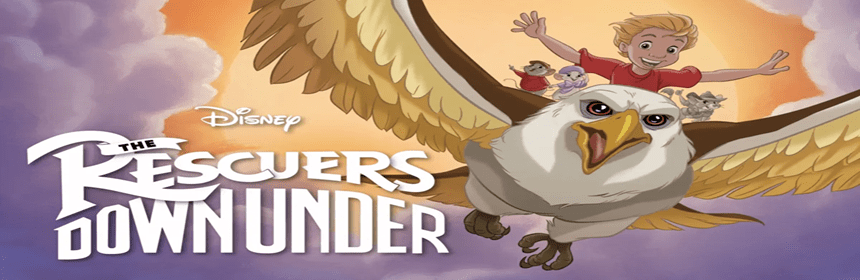
As mentioned in the first blog post in this series, I’ll be writing analysis content on all 60+ Disney animated feature films and their film making eras.
The fifth era is the Renaissance Era, which ran from 1989 to 1999 and started with The Little Mermaid. As mentioned in a previous blog post, the Renaissance Era is known for: the implementation of a Broadway music style, a return to telling legends and fairytales (and bringing back the Disney Princess), brighter and friendlier stories with an emphasis on underdogs on a path to self-discovery, films with more epic scope and scale, and the expansion of computer-generated animation via the introduction of 3D animation and the CAP system.
The Renaissance Era is widely considered Disney’s most successful Era.
So how well did The Rescuers Down Under measure up to these famous features?
Implementation of a Broadway music style:
According to the film’s Wikipedia page, the film makers decided to abandon the musical format from both its predecessor (The Rescuers) and the preceding film of the Renaissance Era (The Little Mermaid). The film makers decided to do this, as they felt that the placement of songs would slow down the film’s pacing, and instead decided to market it as an action-adventure animated film.
According to the film’s IMDb page, this film, along with Tarzan (the last film of the Renaissance Era), are the only films of the Renaissance Era to not be musicals.
A return to telling legends and fairytales (and bringing back the Disney Princess):
This film is the sequel to The Rescuers (1977), which was based on a series of book of the same name by Margery Sharp. There is no Disney Princess in this film.
Brighter and friendlier stories with an emphasis on underdogs on a path to self-discovery:
This film’s themes and its main antagonist aren’t actually bright and friendly at all, in fact they are quite realistic and dark. However, the brighter and friendlier elements of the story are Cody and his relationship with the animals.
Cody, Bernard and Miss Bianca are the underdogs of the film, with Cody being an underdog due to his status as a child in need of rescue, and Bernard and Miss Bianca performing a rescue in a country they have seemingly never been to before.
Films with more epic scope and scale:
Due to being the first 100% digital feature film ever made, this film definitely had an epic scope and scale, especially with its animation of the Australian landscape, and the flying scenes between Cody and Marahute at the beginning of the film. The literal scale between Marahute and Cody is also shown at the beginning of the film, as Marahute can easily fly a human child around with no issue, and McLeach’s tank’s size was emphasised to make the point of how ruthless he really is.
The expansion of computer-generated animation via the introduction of 3D animation and the CAP system:
According to the film’s IMDb page, this film was the first 100% digital feature film ever made. The animation and backgrounds were done traditionally, but all of the colouring, most of the effects, and the final film printing was all done digitally. This also makes it the first Disney film to use the Computer Animated Production (CAP) system. The CAP system cut down the production time for an animated film by at least six months and would be used for another 16 years.
The full utilisation of the CAP system meant that this film achieved many milestones with its animation, including but not limited to being the first animated film to have the appearance of “multi-plane shots”, and being the first Disney animated feature film to use fully rendered computer-generated backgrounds.
To me, its digital nature was obvious as the animation and design seemed crisper and more photo-realistic, in comparison to The Little Mermaid.
My overall thoughts:
Due to its non-musical nature, being a sequel to a film in the previous Era, and being an action-adventure film, for me this film fell flat and frankly doesn’t belong in the Renaissance Era.
It’s not a bad film by any means, but it’s not Disney’s best either. I feel this film would have been better suited to end the Bronze Age. According to the film’s IMDb page, Disney lost interest in the film after a failed reissue of its predecessor but as it was already too far into production to shut it down, Disney decided to finish it and move on. That disinterest clearly showed in the film. I think it might have even been a part of the Bronze Age, if changes in Disney’s management and financial issues hadn’t slowed production down.
On another note, as an Australian, I’m disappointed that there was only one Australian voice actor in the film’s cast.
I honestly believe this film will be the outlier of the Renaissance Era.
The next part of the Disney Era Analysis series will focus on Beauty and the Beast.
Fun Facts and Trivia (according to the film’s IMDb page):
- At 1hr, 17 mins, this is the shortest film in the Renaissance Era.
- Ironically, George C. Scott, who voices McLeach, was actually an animal lover.
- Tristan Rogers was the only actual Australian voice actor in the film (Jake).
- This is the first Disney animated feature film since Bambi to have an overt animal rights/environmental stance.
- This film presumably takes place between December and early March, due to it clearly being summer or autumn in Australia, and due to it clearly being winter in New York.
- This is the only sequel in the Renaissance Era.
- The Rescuers was the last Disney animated feature film of the 1970s. This film was Disney’s first animated feature film on the 1990s.
References:
 Loveday Writing