Disney Era Analysis – The Little Mermaid
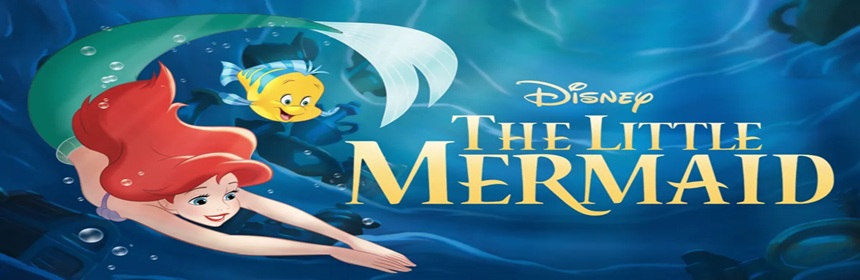
As mentioned in the first blog post in this series, I’ll be writing analysis content on all 60+ Disney animated feature films and their film making eras.
The fifth era is the Renaissance Era, which ran from 1989 to 1999 and started with The Little Mermaid. As mentioned in a previous blog post, the Renaissance Era is known for: the implementation of a Broadway music style, a return to telling legends and fairytales (and bringing back the Disney Princess), brighter and friendlier stories with an emphasis on underdogs on a path to self-discovery, films with more epic scope and scale, and the expansion of computer-generated animation via the introduction of 3D animation and the CAP system.
The Renaissance Era is widely considered Disney’s most successful Era.
So how well did The Little Mermaid measure up to these famous features, and was it the right film to kick off the Era?
Implementation of a Broadway music style:
According to the film’s Wikipedia page, this film has been regarded as one that “brought Broadway into cartoons”. I personally felt that the film, specifically how its plot was structured and when the songs appeared, was like a musical as opposed to a traditional film.
According to the film’s Wikipedia page, the songs for the film were written in a more collaborative manner during the storyboard process, in order to make the songs a more organic part of the film. I personally feel that this worked and that the music did feel organic to the film’s plot.
According to the film’s IMDb page, the song, “Part of Your World” ended up setting a precedent for future Disney animated films where the protagonist would vocalise their desires early in the film. These songs would become known as the “I Want” song.
The successful implementation of a Broadway music style in this film is evident by its adaptation into a Broadway musical in 2007. Subsequent musicals of the film have been performed internationally, with the most recent being a 90-minute Spanish-language production in Argentina in 2025.
A return to telling legends and fairytales (and bringing back the Disney Princess):
This film is loosely based on the 1837 Danish fairy tale of the same name by Hans Christian Andersen.
According to the film’s IMDb page, this is the first Disney film to be based on a fairy tale since Sleeping Beauty, a film from the Silver Age.
Ariel being a princess in the film’s plot cements her status as an official Disney Princess.
Brighter and friendlier stories with an emphasis on underdogs on a path to self-discovery:
The ending of the original fairy tale doesn’t see the mermaid marry the prince and live happily ever after. Therefore, the film’s love story and happy ending, as well as the sea-based analogies and humour interspersed throughout, provide a brighter and friendlier story for young audiences.
In regard to an emphasis on underdogs on a path to self-discovery, this film provides this with Ariel trying to build a life as a human and literal “fish out of water”, as well as trying to gain Prince Eric’s love, whilst beating Ursula at her own game.
Films with more epic scope and scale:
The Little Mermaid definitely had more epic scope and scale, compared to its predecessors of the previous Era, due to it being based on a fairy tale, being more musical-like in terms of its narrative structure, and most of the film’s setting being in a unique underwater world and in a grand castle.
The expansion of computer-generated animation via the introduction of 3D animation and the CAP system:
This film was Disney’s last to use many traditional/analogue methods of animation, specifically the xerography process, designing on a multiplane camera, using hand-painted cels, and analogue camera and film work.
According to the film’s Wikipedia page, computer-generated imagery was used to create some of the wrecked ships in the final battle, a staircase behind a shot of Ariel in Eric’s castle, and the carriage Eric and Ariel are riding in when she bounces it over a ravine. In terms of 3D animation, the objects that were computer-generated were animated using 3D wireframe models.
As this film was the only one in the Renaissance Era and the last one overall to use many of the traditional/analogue methods outlined above, as well as its somewhat limited or minor use of computer-generated imagery and 3D animation, it is regarded as a transitional film – marking the transition from traditional/analogue animation to computer-generated and 3D animation.
My overall thoughts:
Due to it being refreshingly more musical-like in its structure and vibe, the first to be based on a fairy tale in over two decades, and the last Disney animated feature film to use traditional/analogue animation, this film was the perfect one to kick off what would become Disney’s most successful Era. It was definitely a sign of the bigger things to come in this Era.
I personally enjoyed watching this film, in fact I found it captivating, and I can see why it was not only so successful, but how it was successfully adapted into a musical. I enjoyed the adult but not “too adult” humour, especially the adaptation of human phrases and metaphors to apply to the sea life/world. I also appreciated that colour palette changes to match moods, emotions, and vibes. I also enjoyed the “Under the Sea” song and scene.
The next part of the Disney Era Analysis series will focus on The Rescuers Down Under
Fun Facts and Trivia (according to the film’s IMDb page):
- Prince Eric was named after legendary Disney animator, Eric Larson, who passed away one year prior to the film’s release.
- Jodi Benson sang “Part of Your World” in the dark to get that ‘under the sea’ feeling.
- Christopher Daniel Barnes was only 16 years old when he recorded his voice for Prince Eric. The producers felt his voice sounded much older than he really was at the time.
- Ariel is the first Disney animated heroine to have a bare midriff, as well as the first to display cleavage.
- This film is the only one in the Renaissance Era to feature both a female protagonist and a female main antagonist. It was also the final film to feature a female main antagonist, until The Emperor’s New Groove.
- This film was one of the last Disney films to have credits opening it, in contrast, it is the first Disney fairy tale film to feature closing credits.
- Ariel is the first Disney princess to rescue her romantic interest.
- Ariel is the first red-haired Disney princess, she is also the first one to have biological siblings.
References:
- https://en.wikipedia.org/wiki/The_Little_Mermaid_(1989_film)
- https://www.imdb.com/title/tt0097757/
- https://www.imdb.com/title/tt0097757/trivia/?ref_=tt_dyk_trv
- https://en.wikipedia.org/wiki/Disney_Renaissance
- https://en.wikipedia.org/wiki/The_Little_Mermaid_(1989_soundtrack)
- https://en.wikipedia.org/wiki/The_Little_Mermaid_(musical)
- https://en.wikipedia.org/wiki/Disney_Princess
- https://en.wikipedia.org/wiki/Computer_Animation_Production_System
 Loveday Writing