Pixar Era Analysis – Coco
As mentioned in a previous blog post, I’ll be writing analysis content on all 28 of Pixar’s animated feature films and their film making eras.
The third era is the Experimental Era, which ran from 2011 to 2019 and started with Cars 2. As mentioned in a previous blog post, the Experimental Era is known for its large number of sequels, original films that thought outside the box, and an animation style perfected in each film rather than exploring new ground.
So how did Coco measure up to the above features of the Experimental Era?
Large number of sequels:
This film is the last original film of the Experimental Era. According to the film’s Wikipedia page, director, Lee Unkrich, pitched the idea for the film in 2010 when Toy Story 3 was released. His original idea focused on an American child learning about his Mexican heritage, whilst dealing with the death of his mother. Eventually, the production team changed the focus of the film to be on a Mexican child instead.
Original films that thought outside the box:
Coco’s key feature is its revolving around and representation of Mexican culture, specifically the Day of the Dead.
According to the film’s IMDb page, the filmmakers and animators travelled to Mexico five times to research its culture, people, food, and traditions to help define the story and characters of the film. For Lee Unkrich, his experiences in Mexico City and Oaxaca stood out to him and helped fuel his imagination for developing the look of the film, stating that “there was something about the juxtaposition of skeletons with bright, festive colours that captured my imagination. It led me down a winding path of discovery, and the more I learn about Dia de Muertos, the more it affects me deeply.”
Animation style perfected in each film rather than exploring new ground:
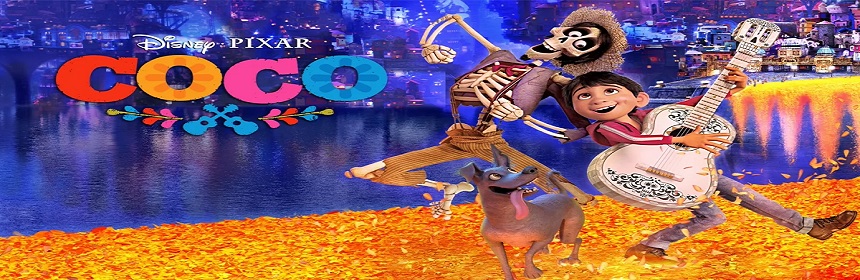
According to the film’s Wikipedia page, Pixar wanted contrast between the Land of the Living and the Land of the Dead, and one of the main techniques in providing this contrast was through colour. The Land of the Dead is much more colourful and vibrant, whereas the Land of the Living’s colour palette was muted in comparison. Also, the flashbacks shown throughout the film were designed to look like old film clips with a sepia tone.
According to the film’s IMDb page, the design of the Cempazuchiti Bridge, between the Land of the Living and the Land of the Dead, incorporates the Aztec pyramids. The vertical structure of the buildings in the Land of the Dead were designed to reflect the layered history of Mexico.
According to the film’s IMDb page, Dante’s tongue was animated using the same technology used for Hank, the septopus, in Finding Dory.
My personal favourite animation moments included the design of the skeletons, the subtle change of translucency of Miguel’s skin as he spends more time in the Land of the Dead, and the paper picado banners being used for Miguel’s narration at the beginning of the film.
My overall thoughts:
Overall, I enjoyed and was very much moved by Coco. Its messages of the importance of family, familial love, ancestry and cultural pride would resonate with everyone, and I personally find the way that Mexico celebrates and commemorates deceased ancestors quite touching and lovely.
After watching two sequels in a row, watching an original film was necessary and a breath of fresh air for me. I appreciated the animation, culture, comedy, and wise and universal messages of the film. I also appreciated the film’s attention to detail, and the subtle, recurring foreshadowing of its twist.
The next part of the Pixar Era Analysis series will focus on Incredibles 2.
Fun Facts and Trivia (from the film’s IMDb page):
- The orange flower seen throughout the film is the Aztec marigold (also known as the Mexican marigold). The flower is used in the tradition of Dia de los Muertos in Mexico to guide the deceased to the living.
- In active production between 2011 and 2017, Coco set the record for being the Pixar film with the longest production schedule.
- The Land of the Dead uses a lot of antiquated technology, e.g. 80s Macintosh computers and walkie-talkie radios. This is fitting, as that technology is obsolete, and albeit, dead.
- Even though the film is named after her, the character Coco is only on screen for less than a quarter of the film’s run time.
- Pixar’s second film to focus mostly on cast members with a specific ethnicity, in the case of this film, being Mexican. The first one was Brave, which focused mostly on actors with a Scottish background.
- Miguel Rivera is the second youngest protagonist to be featured in a Pixar animated feature film, the youngest was Arlo from The Good Dinosaur.
- When recording Miguel’s mournful rendition of ‘Remember Me,’ Anthony Gonzalez was actually in tears.
- This is the third film to show alcohol after Ratatouille and Up.
- In one scene, two skeletons in the background appear to be making a drug deal, passing a package between them suspiciously, a rare instance of a Pixar film to show a drug deal.
- Throughout the film, Hector is barefoot, as shoes in the film are associated with Imelda and her family, from which she has removed Hector. Once Hector is reunited and accepted by the family at the end of the film, he is seen wearing shoes.
- This is the first Pixar film to show an onscreen death of major characters – when Ernesto is crushed to death by the falling bell and when Hector is poisoned and dies. All other deaths in Pixar films have been slightly offscreen, out of view, or not in the scene at all.
References:
 Loveday Writing