Pixar Era Analysis – The Good Dinosaur
As mentioned in a previous blog post, I’ll be writing analysis content on all 28 of Pixar’s animated feature films and their film making eras.
The third era is the Experimental Era, which ran from 2011 to 2019 and started with Cars 2. As mentioned in a previous blog post, the Experimental Era is known for its large number of sequels, original films that thought outside the box, and an animation style perfected in each film rather than exploring new ground.
So how did The Good Dinosaur measure up to the above features of the Experimental Era, and was it the right film to mark the halfway point of the Era?
Large number of sequels:
The Good Dinosaur is an original film, with the screenplay written by Meg LeFauve, who also wrote the film’s story with director, Peter Sohn (in his feature directorial debut), Bob Peterson (the film’s original director), Kelsey Mann, and Erik Benson.
Original films that thought outside the box:
According to the film’s Wikipedia page, the idea for the film and its story came from Peterson wanting to explore the idea of what dinosaurs represent in the present day and how they are represented in stereotypes. Peterson also stated that he was inspired from his impression of the dinosaur animatronics he saw on a visit to the 1964 New York World’s Fair.
Peterson also stated that the film lets the audience “get to know the dinosaur, what it’s really like to be a dinosaur, and to be with a dinosaur,” and that the film is also about Arlo finding a way to feel worthy.
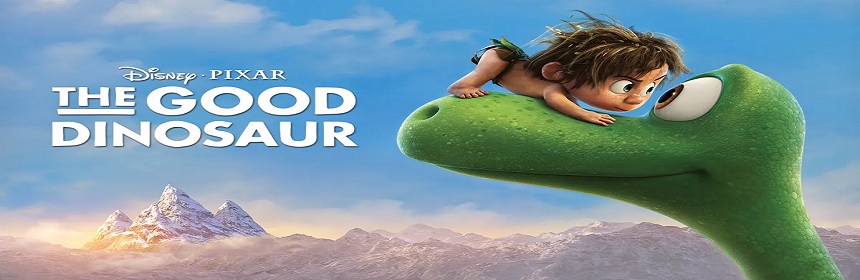
The fact that this film is set in an alternative history where the K-T Extinction Asteroid misses Earth and dinosaurs roam as the apex predator, and yet are human-like (with Spot, the caveboy portrayed as a pet, specifically a dog), proves that it is an original film that thought outside the box.
Animation style perfected in each film rather than exploring new ground:
According to the film’s Wikipedia page, the environments and landscapes in the film are not photo-realistic, they are just detailed in a way that advanced technology and style decisions allowed. That being said, according to the film’s IMDb page, some of the landscapes were so convincingly realistic, some viewers did wonder if they were actually a real-world CGI composite. I personally felt that the animation, specifically of the trees, water, clouds and storms was so beautiful because it looked convincingly realistic.
My overall thoughts:
In my research for this series, I had heard that The Good Dinosaur wasn’t regarded as one of Pixar’s best or strongest. From what I can tell from my research, this would have been primarily due to the multiple production issues that the film experienced from creative differences, story problems, and Pixar multitasking between films, to Pixar making employees redundant and Bob Peterson being replaced as director, which in turn led to the film’s story being completely re-worked. Consequently, this film was the lowest-grossing Pixar film to be released (before Onward in 2020). Ultimately, Pixar staff viewed this film as a good, but not great film.
However, despite the multiple production issues and criticisms, I enjoyed The Good Dinosaur and felt it was a touching film on conquering fears, believing in ones-self, learning from others, and family. I also enjoyed and appreciated the animation of the landscape and nature, even though nature is the antagonist of the film. I believe these reasons and the fact that it is an original, make this the ideal film to mark the halfway point of the Experimental Era.
The next part of the Pixar Era Analysis series will focus on Finding Dory.
Fun Facts and Trivia (from the film’s IMDb page):
- Arlo’s movements were based on those of young elephants.
- This film marked the first time Pixar had released two films in one year, following the release of Inside Out in June 2015.
- According to Sohn, Arlo is approximately 11 years old.
- This film is one of very few dinosaur films where the T-Rexes are not the villains.
- Nature is the antagonist of the film.
References:
 Loveday Writing