Pixar Era Analysis – Finding Dory
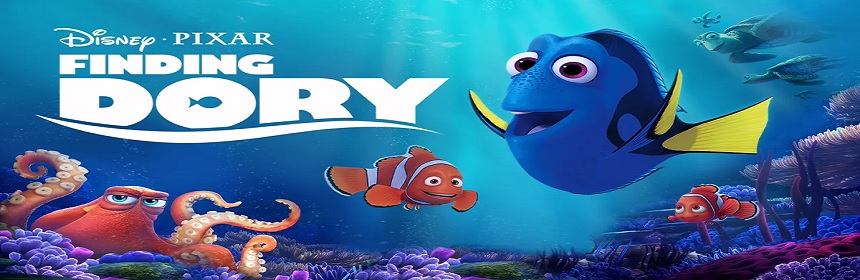
As mentioned in a previous blog post, I’ll be writing analysis content on all 28 of Pixar’s animated feature films and their film making eras.
The third era is the Experimental Era, which ran from 2011 to 2019 and started with Cars 2. As mentioned in a previous blog post, the Experimental Era is known for its large number of sequels, original films that thought outside the box, and an animation style perfected in each film rather than exploring new ground.
So how did Finding Dory measure up to the above features of the Experimental Era?
Large number of sequels:
Finding Dory is the sequel to Finding Nemo, one of the Golden Age films, released in 2003.
Original films that thought outside the box:
Whilst Finding Dory is a sequel to Finding Nemo, it is also a spin-off to the events of Finding Nemo, and a unique film in its own right. Not only is this film about Dory trying to find her parents and vice versa, it is also about Dory’s search for and finding herself (which is what the title alludes to).
The fact that this film is simultaneously a sequel and a spin-off, and has a supporting character turned into a protagonist, proves that it is an original film that thought outside the box.
Animation style perfected in each film rather than exploring new ground:
According to the film’s IMDb page, the thirteen-year gap between the release of Finding Nemo and this film enabled Pixar to figure out how to animate certain things that they couldn’t animate when making Finding Nemo. One of those things was the octopi.
Hank only has seven tentacles, making him a “septopus” according to Dory, as the animators couldn’t fit eight onto his body, so his backstory was rewritten to account for the missing one.
Some favourite animation moments for me included the attention to detail in showing that Hank left water/goo behind wherever he’d go, young Dory, Jenny and Charlie being made transparent when adult Dory would recall certain memories (outside of the flashbacks), and Hank’s first appearance as he comes out of his first disguise as a cat on a poster, as it reminded me of the Salvador Dali painting, The Persistence of Memory.
My overall thoughts:
Overall, whilst I enjoyed the film and felt that the story was a natural progression from the previous film, I feel that this film – both in itself and as a sequel – isn’t the strongest that Pixar has produced. Whilst the story is charming and touching, it is predictable and lacks any real surprises or twists that its predecessor film was filled with. It is a good but not great film.
The next part of the Pixar Era Analysis series will focus on Cars 3.
Fun Facts and Trivia (from the film’s IMDb page):
- This is the second Pixar film with no antagonist whatsoever, aside from minor antagonists like the Giant Squid, the other film is Inside Out.
- Most of the animals in this film have a handicap or disability: Hank has a missing tentacle, Dory has short-term memory loss, Nemo has a small fin, Destiny has nearsighted blindness, Becky is implied to be mentally slow, and Bailey has (or had) a head injury. This is the first Pixar film to feature a character (let alone multiple characters) with a handicap or disability.
- This is Pixar’s first PG-rated film to not contain death.
- This is the third Pixar film to have a lead female role, the previous two films were Brave and Inside Out.
- Ed O’Neill and Ty Burrell (who co-starred together on Modern Family) were unaware of each other’s presence in the film until much later into production.
References:
 Loveday Writing