Disney Era Analysis – Peter Pan
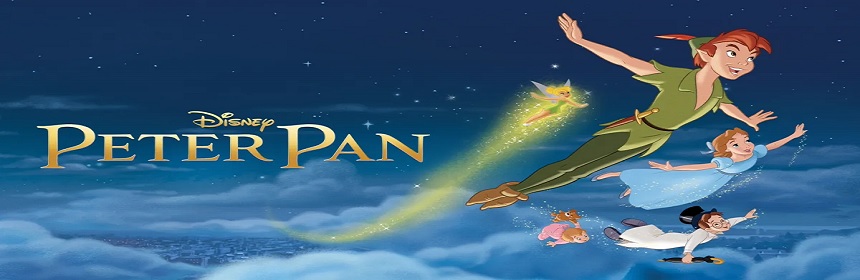
As mentioned in the first blog post in this series, I’ll be writing analysis content on all 60+ Disney animated feature films and their film making eras.
The third era is the Silver Age, which ran from 1950 to 1967 and started with Cinderella. As mentioned in a previous blog post, the Silver Age is also known as the “restoration age,” as the films during this era returned to Disney’s roots of feature-length narratives and adaptations of famous narratives, having high-art animation, being approachable (cartoonish gags, music from contemporary artists, and a lighter approach to storytelling), steering clear of intense scenes, and being heartwarming with happy endings, good morals, and catchy songs.
So how well did Peter Pan measure up to these famous features?
Returning to Disney’s roots of feature-length narratives and adaptation of famous narratives:
Peter Pan is based on J.M. Barrie’s 1904 play, Peter Pan, or The Boy Who Wouldn’t Grow Up.
Having high-art animation:
Like its Silver Age predecessors, Disney used live-action models for its animation. The voice actor for Wendy, Kathryn Beaumont (who also voiced Alice in Alice in Wonderland) was also the live-action model for Wendy. Beaumont stated in an interview that she had to hold out her arms and pretend to fly for all the scenes requiring it.
According to the film’s IMDb page, supervising animator, Milt Kahl, recalled that he had a particular challenge on this film. He had to learn how to animate a character’s weightlessness, as most of the time, Peter Pan was not flying but floating in mid-air. Kahl also said that he solved this problem by having Peter’s upper body arrive first, with his lower body catching up afterward.
The film’s IMDb page also stated that Disney didn’t rely on or use rotoscoping, like they did with previous films, instead the live-action reference footage was used as a guide for animating by studying the human movement in the situation required.
The film’s IMDb page also stated that Wendy’s hair was tied back throughout the film to make it easier for the animators.
Being approachable (cartoonish gags, music from contemporary artists, and a lighter approach to storytelling):
Cartoonish gags:
I personally felt the scenes involving the Crocodile and Captain Hook were cartoonish.
Music from contemporary artists:
The majority of the music from the film came from the creative musical talents of Frank Churchill, a veteran Disney songwriter, Sammy Cahn, known for his songwriting experience on Broadway, Sammy Fain, who contributed to The Great American Songbook, and Oliver Wallace, a composer whose work appeared in multiple Disney films.
One of the film’s songs, “What Made the Red Man Red?” became controversial due to its racist, stereotypical portrayal of Native Americans. Over the years, the song has either been altered or omitted from various Peter Pan musicals and adaptations.
A lighter approach to storytelling:
According to the film’s IMDb page, the film was originally intended to have a darker ending and in the play, Peter Pan was originally written to be a heartless sociopath who would kill off Lost Boys to prevent an overpopulation and a challenge to his authority.
Whilst Walt Disney was dissatisfied with the finished film, mostly due to the fact that he felt Peter Pan was cold and unlikeable, I felt that Disney’s choice to add several musical numbers and imply the possibilities that the whole adventure was a dream Wendy had and one that her father experienced during his own childhood, provided a lighter approach to the storytelling.
Steering clear of intense scenes:
I felt that the scene with Peter being given the bomb and the countdown was a little intense, but other than that, I felt the film mainly steered clear of intense scenes.
Being heartwarming with happy endings, good morals, and catchy songs:
In terms of being heartwarming with happy endings, the film begins with Wendy in conflict with her father, George, over her telling her younger brothers the story of Peter Pan and growing up, and it ends with George happily agreeing to let Wendy stay in the nursery with her brothers. The ending even has George recognising Peter’s ship from his own childhood, implying he went on a similar adventure.
In terms of the film’s morals, the main one is that growing up is a necessary part of life, however some other morals present in the film include: that it’s okay to not want to grow up, it’s okay to have fun sometimes, thinking happy thoughts is important, and to go on adventures.
In terms of catchy songs, I believe “Second Star to the Right,” “You Can Fly!,” “A Pirate’s Life,” “Following the Leader,” and “Never Smile at a Crocodile” were the catchiest ones.
My overall thoughts:
Overall, while I appreciated the beautiful animation and themes, I did find Peter Pan hard to enjoy as I found the protagonist unlikeable and hard to engage with (I know this is in part due to the writing of his character in the play), the plot lost momentum when it should have gained it, and while I’m aware of how long ago this film was made, I definitely can’t overlook the blatant racism with the Native Americans scenes.
On a side note, I found it interesting that this was another Silver Age film that Walt Disney was dissatisfied with (the other being its predecessor, Alice in Wonderland).
The next part of the Disney Era Analysis series will focus on Lady and the Tramp.
Fun Facts and Trivia:
- The Darling children become very sleepy as their parents leave the room. This is due to the “tonic” given to them just as they are going to bed. It was quite common in the early 20th century to give children “tonics” to control their behaviour, and consisted of several different narcotics, including morphine.
- Bobby Driscoll (Peter Pan), as a voice actor, was the first male to play Peter Pan on film.
- Peter Pan and Wendy resemble their respective voice actors, Bobby Driscoll and Kathryn Beaumont.
- Peter Pan was originally supposed to have wings.
References:
- https://en.wikipedia.org/wiki/Peter_Pan_(1953_film)
- https://www.imdb.com/title/tt0046183/trivia/?ref_=tt_trv_trv
- https://en.wikipedia.org/wiki/What_Made_the_Red_Man_Red%3F
- https://www.hercampus.com/school/siena/life-lessons-ive-learned-disney-movies-peter-pan/
- https://disney.fandom.com/wiki/Peter_Pan_(film)
- https://disney.fandom.com/wiki/Peter_Pan_(soundtrack)
 Loveday Writing