Disney Era Analysis – Alice in Wonderland
As mentioned in the first blog post in this series, I’ll be writing analysis content on all 60+ Disney animated feature films and their film making eras.
The third era is the Silver Age, which ran from 1950 to 1967 and started with Cinderella. As mentioned in a previous blog post, the Silver Age is also known as the “restoration age,” as the films during this era returned to Disney’s roots of feature-length narratives and adaptations of famous narratives, having high-art animation, being approachable (cartoonish gags, music from contemporary artists, and a lighter approach to storytelling), steering clear of intense scenes, and being heartwarming with happy endings, good morals, and catchy songs.
So how well did Alice in Wonderland measure up to these famous features?
Returning to Disney’s roots of feature-length narratives and adaptation of famous narratives:
Alice in Wonderland is an adaptation of Lewis Carroll’s 1865 novel of the same name, as well as its 1871 sequel, Through the Looking-Glass.
Having high-art animation:
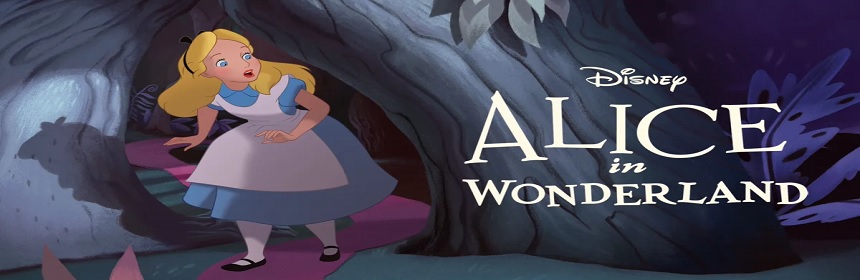
According to the film’s IMDb page, the film’s concept art was provided by artist, Mary Blair. Her art for the film used bold and unreal colours, and was much different than John Tenniel’s original illustration in the Alice books. Art and animation historians have credited Blair with introducing Modernist art to Disney animated feature films.
Like its predecessor, Disney used live-action model for its animation. Alice’s voice actor, Kathryn Beaumont, served as the live-action model for Alice, and even dressed as Alice as she was portraying her. Beaumont also sat in a scale-model house that was constructed for the animation of the scenes in the White Rabbit’s house.
Being approachable (cartoonish gags, music from contemporary artists, and a lighter approach to storytelling):
Cartoonish gags:
As the Alice books is an example of literary nonsense, you could argue that the majority of the film is a cartoonish gag in itself. However, I believe that the scenes with Tweedledee and Tweedledum, as well as the Tea Party scene and the scenes involving the Queen of Hearts and the trial, are the most cartoonish gag-like of the film.
Music from contemporary artists:
According to the film’s Wikipedia page, over 30 potential songs were written for the film and many of them were included in it, but some of them were only included for a few seconds. Walt Disney also hired Tin Pan Alley songwriters again, however the only song written by them that made it into the film was “The Unbirthday Song.”
According to the film’s IMDb page, the title song, “Alice in Wonderland” was composed by Sammy Fain, with its lyrics written by Bob Hilliard. The song was later used by jazz pianist, Dave Brubeck, and has gone on to become a jazz standard.
A lighter approach to storytelling:
I felt that the lighter approach to storytelling came from the vibrant colours and art style implemented by Blair and Disney. The vibrant colours added to the nonsensical vibe that ultimately comes from Alice’s literary nonsense routes.
Steering clear of intense scenes:
The film manages to mostly stay away from intense scenes, however I feel that the trial scene, specifically as Alice tries to escape from the Red Queen, is intense.
Being heartwarming with happy endings, good morals, and catchy songs:
In terms of its ending, Alice discovering that her surreal, risky and nonsensical adventure was just a dream, both makes sense but is also cliché.
In terms of its morals, there are many takeaways both from the books and this film from risk having rewards (and consequences), figuring out who you are, standing up for yourself, to understanding logic, and respecting (but also sometimes challenging) authority.
In terms of catchy songs, the stands out to me were “I’m Late,” “The Caucus Race,” “How Do You Do and Shake Hands,” “Painting the Roses Red,” and “The Unbirthday Song.”
My overall thoughts:
Overall, I felt that the film was a good adaptation of both Alice books, however as I don’t usually read or watch films based in literary nonsense, I did find the film a little hard to engage with.
I also found it interesting to discover in my research on the film that Walt Disney regarded this film as one of his biggest regrets and that the film was received negatively by Lewis Carroll fans, due to Disney Americanising the Alice books.
The next part of the Disney Era Analysis series will focus on Peter Pan.
Fun Facts and Trivia:
- According to the film’s IMDb page, Alice was the last female to be looked over by Walt Disney that didn’t have a love interest in her film.
- The White Rabbit is best remembered for repeatedly exclaiming that he is late, though it is never clarified to what date, event, or activity he is late for.
- According to the film’s IMDb page, this film has more songs and characters than any other Disney animated feature film.
- Interestingly, the Doorknob was the only character in the film that did not appear in the books.
- This film is the only Disney animated feature film that had to wait more than 20 years for its first theatrical re-release.
- This is the first Disney animated feature film set in the UK.
References:
- https://en.wikipedia.org/wiki/Alice%27s_Adventures_in_Wonderland
- https://en.wikipedia.org/wiki/Alice_in_Wonderland_(1951_film)
- https://en.wikipedia.org/wiki/Literary_nonsense
- https://en.wikipedia.org/wiki/John_Tenniel#Alice
- https://everymancommentary.com/a-tale-of-two-alices/
- https://www.youtube.com/watch?v=yas5jonZuKg
- https://www.acmi.net.au/stories-and-ideas/five-life-lessons-alice-wonderland/
- https://www.alice-in-wonderland.net/resources/analysis/moral/
- https://owlcation.com/humanities/Alice-in-Wonderland-What-Intriguing-Message-Does-it-really-Hold
- https://disney.fandom.com/wiki/Alice_in_Wonderland_(soundtrack)
 Loveday Writing