Pixar Era Analysis – Monsters, Inc.
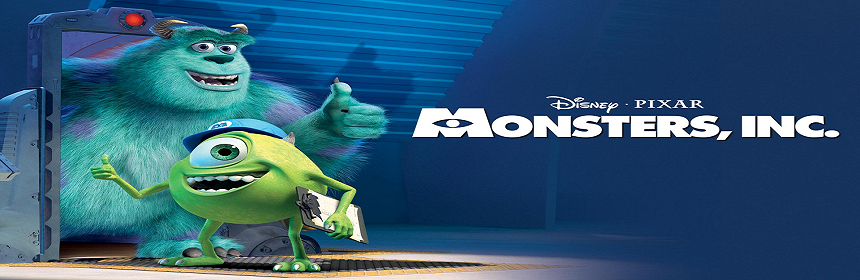
As mentioned in a previous blog post, I’ll be writing analysis content on all 27 of Pixar’s animated feature films and their film making eras.
The first era is the Golden Age, which ran from 1995 to 2004 and started with Pixar’s debut animated feature film, Toy Story. As mentioned in a previous blog post, the Golden Age is known as the Age where Pixar pioneered and highlighted their then-new technological style, and made films that focused on great attention to detail and storytelling, with each film evolving from the previous one, with their debut film, Toy Story, setting the precedent. The films in this Age also focused on themes of hope, happiness, and togetherness.
So how did Monsters, Inc. measure up to the above features of the Golden Age?
Pioneered and highlighted their then-new technological style:
Monsters, Inc. was a pioneer in terms of animating and rendering fur. According to Wikipedia, Pixar’s animated and technical teams made an intense effort to ensure that fur was animated properly and done justice.
According to IMDb, it would take around 11-12 hours to render a single frame of Sulley because of his 2.3 million animated hair strands (the total number of hairs were 2,310,413). Part of the animation process included the use of moving attractor/repeller particles that functioned like virtual magnets, conducting a fur test where Sulley would run in an obstacle course to see how his fur would move, and creating a new fur simulation program called, Fizt.
According to IMDb, computing power is measured in rendermarks. Pixar’s previous film, Toy Story 2, required 1.1 million rendermarks, this film took 2.5 million, twice more, illustrating the improvements in the film and animation quality, as well as the technology at the time.
Made a film that focused on great attention to detail and storytelling:
Monsters, Inc.’s story is summed up in the first paragraph of its Wikipedia page:
“In a world inhabited by monsters, the city of Monstropolis harnesses the screams of human children for energy. At the Monsters, Incorporated factory, skilled monsters employed as ‘scarers’ venture into the human world to scare children and harvest their screams, through doors that activate portals to the children’s bedroom closets. The work is considered dangerous, as human children are believed to be toxic and capable of killing a monster through physical contact. Energy production is declining because children are becoming less easily scared, and the company’s CEO, Henry J. Waternoose III, is determined to prevent the company’s collapse.”
The inciting incident of the film is when Sulley finds an active door left in the station of his rival, Randall, and he opens the door, which accidentally lets a little girl, Boo, into the factory and monster’s world.
The film then goes on to have Sulley having to look after and hide Boo until he can send her home. Throughout the course of the film, Sulley realises that she is not toxic and that her laugh can generate more energy than screams. Sulley also acts like a new father at first, and slowly finds his footing along the way, with Boo eventually ending up meaning more to him than his work.
After a few mishaps and finding out that the Waternoose is working with Randall in order to keep the company afloat, Sulley eventually gets Boo home. He then becomes CEO of Monsters, Incorporated, after his discovery that laughter generates more energy than screams resolves Monstropolis’ energy crisis. With help from Mike, he is able to reunite with Boo at the end of the film.
I personally appreciated the attention to detail on not only the monsters’ looks, but also the fact that scaring children and the concept of “monsters in the closet” is an industry in this film. I also appreciated that each child’s door is unique to them and their bedroom.
Setting the precedent for future films:
This isn’t so much setting a precedent, but rather the film contains several Easter eggs hinting at what Pixar’s next film will be about, and in this case, it’s Finding Nemo. According to IMDb, these Easter eggs included: a painting of Nemo on the wall of Harryhausen’s restaurant, a statue of Nemo in the wall of a child’s bedroom, and Boo handing Sulley a Nemo toy.
Themes of hope, happiness, and togetherness:
Hope – When Sulley discovers that children’s laughter can provide more power to Monstropolis than their screams, this provides hope for him and the population that this will resolve the energy crisis and keep Monsters, Incorporated afloat.
Happiness – Monsters, Inc.’s focus on happiness is key to their plot as happiness, specifically children’s laughter, is what saves Monstropolis from a long-term energy crisis and saves Monsters, Incorporated as a company. Sulley also spends the majority of his time with Boo trying to make her happy.
Togetherness – Monsters, Inc. focuses on togetherness through Sulley’s developing relationship with Boo, as well as his long-term friendship with Mike, which is illustrated by the fact that they have been working and living together for a long time.
My overall thoughts:
Overall, I enjoyed the film, especially the exploration of the “monsters in the closet” concept as an industry. I appreciated that the film was different to Pixar’s previous three films in that it started off like a horror movie and at a slower pace, although at times it did feel like the pace was a little too slow. I also appreciated that it was written in a way that Boo’s adventures could be explained away as a vivid dream when she wakes up the next morning.
The next part of the Pixar Era Analysis series to be released will focus on Finding Nemo.
Fun Facts and Trivia:
- John Goodman pushed for Steve Buscemi to voice Randall.
- In early drafts, the character of Boo was written to be six years old. The writers decided to make Boo younger because it would make her more dependent on Sulley.
- Boo’s real name is Mary, as shown briefly on one of the crayon drawings she shows to Sulley in the scene where Boo is going to sleep on Sulley’s bed. The actress who provided the voice of Boo is Mary Gibbs.
- To get Mary Gibbs to laugh on cue, Pete Docter would entertain her with sock puppets in the recording booth.
- Sulley’s full name is James P. Sullivan, named as a homage to Pat Sullivan, the famous animator responsible for creating Felix the Cat.
- Each of the main characters (Sulley, Mike and Boo) were assigned their own individual animator.
- The only Pixar film of the 2000s to have bloopers.
- The idea for the film was first conceived over a lunch between John Lasseter, Pete Docter, Andrew Stanton and Joe Ranft in 1994 during the production of Toy Story.
- Production briefly shut down following the September 11 attacks.
- All of Boo’s drawings in the film were authentic kid drawings that were scanned into the computer for use in the film.
- Pete Docter’s directorial debut.
- Monsters, Inc. is the first Pixar film to have a prequel. Monsters University was released 12 years later.
- Monsters, Inc. is the first Pixar film to be released in the 21st century.
References:
 Loveday Writing