Disney Era Analysis – Saludos Amigos
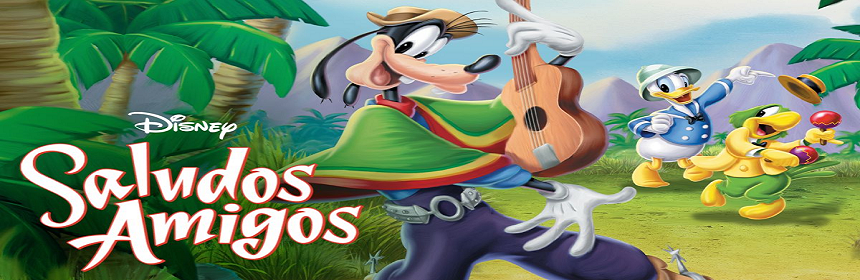
As mentioned in the first blog post in this series, I’ll be writing analysis content on all 60+ Disney animated feature films and their film making eras.
The second era is the Wartime Era, which ran from 1943 to 1949 and started with Saludos Amigos. As mentioned in my previous blog post, the Wartime Era is also known as the “package era” as the films during this era were famous for consisting of multiple segments or short films with varying plots (or sometimes no plots at all) that were put together, as opposed to being a film focusing on or telling one concrete story. This era was also known for combining live action with animation. This era was also known for showing how World War II affected the Walt Disney Animation Studios.
So how well did Saludos Amigos measure up to these famous features and was it the right film to kick off the Wartime Era?
Consisting of multiple segments or short films with varying plots (or sometimes no plots at all) that were put together:
Saludos Amigos consisted of four different segments: Lake Titicaca, Pedro, El Gaucho Goofy, and Aquarela do Brasil.
Lake Titicaca:
This segment focuses on Donald Duck visiting Lake Titicaca, on the border of Bolivia and Peru, where he meets some of the locals and takes pictures, as well as his journey riding a llama that is controlled by playing melodies with a flute.
Pedro:
This segment is all about Pedro,an anthropomorphic plane based at an airport near Santiago, Chile, with his parents. One day, Pedro is sent on his first flight to retrieve mail from Mendoza, Argentina. The route involves flying through the Andes and by Aconcagua, the highest mountain in the Western and Southern Hemispheres. Whilst it looks like Pedro has crashed, he manages to make it back to his home airport safely with a singular postcard.
El Gaucho Goofy:
This segment focuses on American cowboy, Goofy, being taken away from Texas by the narrator to the Argentinian Pampas, the home of the South American cowboy-equivalent, the Gaucho. Goofy learns how to be a Gaucho and live his life as one, with his cheeky horse.
Aquarela do Brasil (Watercolor of Brazil):
This segment has Donald Duck being given a tour of Brazil by Jose Carioca, an anthropomorphised native parrot, with the artist painting the scenery and landscape as Donald and Jose samba their way around. The segment also has Donald getting drunk from cachaca, thinking it’s South American soda.
All of these segments told individual stories, with the only links being the location of South America, and Donald Duck’s appearance in the opening and ending segments.
Combining live action with animation:
This film was mostly animation, with the only live actions moments consisting of Disney staff getting on the plane to travel to South America, and the artists/animators working on their sketches of what they would see whilst on tour, as well as archive footage of the various locations and the locals.
Showing how World War II affected the Walt Disney Animation Studios:
This film, as well as its successor, The Three Caballeros were made by Disney to improve the relationship between the United States of America and South American countries during the War.
As many South American countries were expressing an affiliation with Nazi Germany, the US Government requested that Walt Disney and his staff go on a ‘Goodwill Tour’ to help prevent South America from becoming a Nazi Germany ally. Saludos Amigos was the first film that came out of the tour, with Donald Duck and Goofy being chosen as the protagonists as they were popular characters in South America.
Whilst this film and the others in this Era were partly funded through the US government, they were also made to cut costs at Disney’s animation studios.
My overall thoughts:
Overall, I felt that Saludos Amigos was well formatted, using an animated map, live animation, and location to frame the film as a whole and provide breaks and segues between each segment. Personally, my favourite segment was Pedro as I found the animation, protagonist, and overall story endearing.
According to IMDb, the critical reception of the film in both the USA and South America has been mixed in the years since its release. Critics, film historians, and various writers have seen the film in different lights over the years from being an interesting introduction to South America, a boring travel brochure film, to dispelling negative stereotypes and propagating them. The intentions behind the film’s creation was also questioned, with it being seen by some as a product of cultural diplomacy and by others as a work of propaganda (Walt Disney did make some propaganda films for the US government). I watched this film on Disney Plus, which had a content warning about the cultural depictions, watching the film, I can see why the warning was needed and some of the criticisms of the depiction of the locals are valid. However, one needs to remember that the film was made 80 years ago and society and the world was different. Does this make the depictions okay, morally? No, however the animation and storytelling, as well as Disney’s animated feature films have improved and grown since this time.
On a general level, whilst it was well formatted, the change from Bambi to Saludos Amigos was jarring, and I found it hard to stay engaged with the film. However, I did appreciate the film’s meta references from the narrator interacting with Goofy in El Gaucho Goofy and Donald Duck in Lake Titicaca, to the scenery being painted as the story progressed in Aquarela do Brasil.
Overall, I feel that Saludos Amigos was a good film to kick off this era due to its easy to follow format and segments, some of its educational value, and its run time.
The next part of the Disney Era Analysis series will focus on The Three Caballeros.
Fun Facts and Trivia:
- The segments or shorts were originally intended to be released separately, but they ended up being combined when it was decided that each short would only appeal to the people whose country it depicted. Footage of the Disney team on location was used as the framing sequence around the segments/shorts.
- This film is the shortest Disney animated feature film to date at 42 minutes in duration.
- The footage of Disney staff boarding the plane was staged after the trip when the decision was made to use home-movie footage as the framing sequence. Walt Disney realised that they had no footage of the real boarding, so everyone dressed in the same outfits they left with and shot footage of them leaving the studio and boarding the plane.
- This film marks Donald Duck’s first appearance in a Disney animated feature film, he had previously appeared in animated shorts.
- Pedro is the only segment/short to feature no previously established characters.
- This was the first Disney animated feature to be shown in South America before it was screened in the USA.
- The postcard in Pedro is addressed to Jorge Delano, a well-known Chilean cartoonist and filmmaker who was instrumental in bringing Walt Disney and his staff to Chile during their tour.
- Saludos Amigos means ‘hello friends’ in Spanish.
- The first Disney animated feature film to be released in February.
- Saludos Amigos wasn’t released for home entertainment until 1995.
References:
 Loveday Writing