Disney Era Analysis – Dumbo
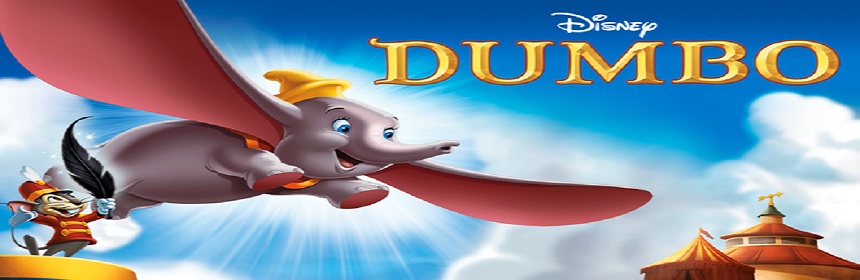
As mentioned in a previous blog post, I’ll be writing analysis content on all 60+ Disney animated feature films and their film making eras.
The first era is the Golden Age, which ran from 1937 to 1942 and started with Disney’s debut animated feature film, Snow White and the Seven Dwarfs. As mentioned in my previous blog post, the Golden Age is known for setting the now-famous features in Disney’s animated feature films – being based on fairy tales, taking well-known literature and turning it into a child-friendly film, movies about and from the perspective of anthropomorphic animals, exaggerated villains, musical moments, adventures, and comedic sidekicks.
So how did Dumbo measure up to these now-famous features and was it the right film to follow the Golden Age’s outlier film, Fantasia?
Being based on fairy tales:
Dumbo is based on the children’s book, Dumbo, the Flying Elephant, by then-married couple, Helen Aberson and Harold Pearl, and is not a fairy tale.
Taking well-known literature and turning into a child-friendly film:
As mentioned above, the film is based on the children’s book, Dumbo, the Flying Elephant by Helen Aberson and Harold Pearl. The story was sold to Roll-a-Book Publishers Inc, which published novelty books with illustrations on a long scroll contained in a box. However, before the book could go into production, the story and its intellectual property rights were sold to Disney in 1939.
Dumbo was released as a children’s book on 1 January 1941, with the film being released in October the same year.
Movies about and from the perspective of anthropomorphic animals:
This movie revolves completely around anthropomorphic animals, and not just the titular character.
The movie revolves around anthropomorphic animals who are part of a travelling circus. For the majority of the film’s run time, each species of animal stick with their own kind, with the elephants being the only group of animals with any dialogue, due to the titular character being an elephant. The group of elephants (not including Mrs. Jumbo and Dumbo) are portrayed as snobby and gossipy women and actually have more dialogue than Mrs. Jumbo, who only has one line, and Dumbo, who has no lines at all. The only other animals in the film to have lines are Timothy Q. Mouse and the crows.
Even though Dumbo has no lines, he still has a personality which is expressed through his signature ears, playfulness, and facial expressions. Interestingly, there is an anthropomorphic train, Casey Junior, who can be heard talking and singing as he goes.
Exaggerated villains:
I feel that there are two groups of villains in this film – the humans (the Ringmaster, his human circus performers, and the human attendees), and the group of elephants.
The human attendees are villains for their bullying and mistreatment of Dumbo. The Ringmaster and his human circus performers are villains for their subsequent detaining of Mrs. Jumbo for trying to protect Dumbo, as well as their general mistreatment of the elephants (including Dumbo) during the performances.
The group of elephants are, what I’d call, minor villains. I’ve labelled them as villains due to their gossipy nature and bullying of Mrs. Jumbo and Dumbo, however they are minor villains as they verbally, not physically taunted them.
Interestingly, according to IMDb, this is the first Disney animated feature film to not include a clear, main antagonist (with the possible exception of the Ringmaster).
Musical moments:
The film’s soundtrack consists of only eight songs, with its most well known being, “Baby Mine” and “Pink Elephants on Parade.” “Baby Mine” can be heard during one of the film’s most emotional moments, when Timothy Q. Mouse takes Dumbo to see his mother and she cradles him from inside the circus wagon with her trunk, as neither one of them can give the other a hug. “Pink Elephants on Parade” is the song that can be heard during the hallucination sequence, which Timothy and Dumbo experience after accidentally becoming intoxicated by drinking spiked water.
Another key musical moment is with the song “When I See an Elephant Fly” which is sung by the crows as they make fun of Dumbo’s attempts to fly, however a reprise of the song can also be heard in the film’s final moments when Dumbo achieves success.
Adventures:
This film didn’t contain the traditional adventures seen in Snow White and the Seven Dwarfs and Pinocchio. While Dumbo and the other animals were part of the travelling circus, the details of their travels weren’t really covered. However, you could argue that Dumbo would go on adventures off screen once he achieved fame and success, especially as the film ends with the circus moving on to the next town.
Comedic sidekicks:
Timothy Q. Mouse and the crows were the comedic sidekicks in the film.
The crows have generated controversy over the years due to portraying African-American stereotypes. According to IMDb, the lead crow was named ‘Jim Crow’ (later renamed Dandy Crow) to give a sarcastic jab to the Jim Crow laws in Southern USA. Other than ‘Jim Crow,’ who is voiced by Caucasian actor, Cliff Edwards, the other crows are voiced by African-American voice actors. There have been some counter-arguments against this, such as the fact that they are the only sympathetic characters other than Dumbo, Mrs. Jumbo, and Timothy, and that they apologise for picking on Dumbo and Timothy, and teach Dumbo how to fly. As a Caucasian Australian, I feel it’s not my place to say whether the crows were portraying African-American stereotypes, or not.
My overall thoughts:
According to IMDb, Dumbo was a tightly-budgeted, scripted, and produced film due to Disney’s need for revenue after the expensive failures of Pinocchio and Fantasia. This was obvious to me as I watched the film, due to its shortened run time, simplistic story, lack of dialogue, and simplistic animation of human characters.
Despite the limitations that were placed on Disney and his staff, they still aimed and wanted Dumbo to tell a good quality story, and I feel that they succeeded by going with a more emotive story (with some surrealism-like animation thrown in that was relevant to the story).
The effects of World War II could also be felt with this film, both on and off screen. On screen, Dumbo is used as the mascot for a war-like recruitment poster and off screen, Dumbo was planned to be on the cover of TIME magazine in December 1941, however this plan was scrapped due to the attack on Pearl Harbor.
I feel that Dumbo is the perfect example of what Disney can do with limited resources, and was the perfect follow-up to the lengthy outlier of the era, Fantasia.
The next part of the Disney Era Analysis series will be released next week and will focus on Bambi.
Fun Facts and Trivia:
- Dumbo is the first and only protagonist in a Disney animated feature film to have no spoken dialogue.
- Dumbo was one of Walt Disney’s favourite films.
- This is the first Disney animated feature film (and still one of very few) to be set in America. This is also one of very few of their films to be set in the (then) present of 1941.
- This was the last Disney animated feature film released before the entry of the United States of America in World War II.
- This is the top film that has been re-released on DVD and VHS in movie history.
- Dumbo is the first low-budget Disney animated feature film.
- Dumbo is the first Disney animated feature film to play on TV in 1955.
- Dumbo wasn’t released in Finland and Japan until 1948 and 1954 respectively.
- According to IMDb, the film has a somewhat circular structure, because it opens with white storks flying, and closes with black crows flying in a similar formation.
References:
- https://en.wikipedia.org/wiki/Dumbo
- https://disney.fandom.com/wiki/Dumbo_(1941_film)
- https://en.wikipedia.org/wiki/Helen_Aberson-Mayer
- https://en.wikipedia.org/wiki/Baby_Mine_(song)
- https://en.wikipedia.org/wiki/Pink_Elephants_on_Parade
- https://disney.fandom.com/wiki/Baby_Mine
- https://disney.fandom.com/wiki/When_I_See_an_Elephant_Fly
- https://disney.fandom.com/wiki/Casey_Junior
- https://disney.fandom.com/wiki/Roustabouts_(song)
- https://www.bedtimeshortstories.com/dumbo-the-flying-elephant-story/amp
- https://www.dailymail.co.uk/news/article-6869005/Author-Dumbo-book-died-heartbroken-aged-91-never-getting-recognition-deserved.html#comments
- https://www.smithsonianmag.com/innovation/in-its-intended-format-original-dumbo-story-would-have-had-more-twists-and-turns-180971785/
- https://www.goodreads.com/en/book/show/9122335
- https://en.wikipedia.org/wiki/Attack_on_Pearl_Harbor
 Loveday Writing