Disney Era Analysis – Fantasia
As mentioned in a previous blog post, I’ll be writing analysis content on all 60+ Disney animated feature films and their film making eras.
The first era is the Golden Age, which ran from 1937 to 1942 and started with Disney’s debut animated feature film, Snow White and the Seven Dwarfs. As mentioned in my previous blog post, the Golden Age is known for setting the now-famous features in Disney’s animated feature films – being based on fairy tales, taking well-known literature and turning it into a child-friendly film, movies about and from the perspective of anthropomorphic animals, exaggerated villains, musical moments, adventures, and comedic sidekicks.
So how did Fantasia measure up to these now-famous features and was it the right film to mark the halfway point of the Golden Age?
Fantasia is an outlier
For this analysis, it’s important to point out that Fantasia is the outlier of this era. Fantasia is an anthological film, rather than a film with a plot, and consists of eight animated segments set to pieces of classical music:
- Toccata and Fugue in D Minor
- The Nutcracker Suite
- The Sorcerer’s Apprentice
- Rite of Spring
- Intermission/Meet the Soundtrack
- The Pastoral Symphony
- Dance of the Hours
- Night on Bald Mountain
The majority of the music is played/performed by the Philadelphia Orchestra, conducted by Leopold Stokowski, with Deems Taylor, music critic and composer, acting as the film’s Master of Ceremonies (or MC), who introduces the film, as well as each segment within it.
The live action moments of Taylor introducing the film and each segment, as well as a brief intermission, also make this film unique. Rather than being a movie with a story to escape into it, Fantasia is more like a night at the theatre, this is due to the fact that it was also released as a theatrical roadshow across the U.S. between 1940 and 1941.
Being based on fairy tales:
Only the Nutcracker Suite is based on a fairy tale as it is from the classical ballet, The Nutcracker, which is based on the 1816 fairy tale, The Nutcracker and the Mouse King.
Taking well-known literature and turning into a child-friendly film:
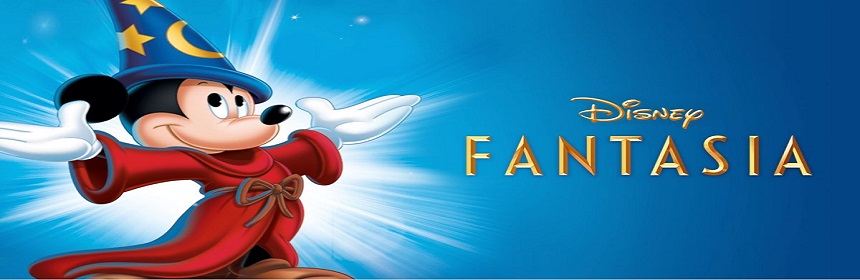
The Sorcerer’s Apprentice is Fantasia’s signature segment due to Mickey Mouse portraying the apprentice and his portrayal is used in the marketing for the film. The Sorcerer’s Apprentice is a symphonic poem by French composer, Paul Dukas, which in turn was based on Johann Wolfgang von Goethe’s poem, Der Zauberlehrling. Its adaptation by Disney actually made it more well-known to audiences, and the animation makes it a child-friendly short.
The other segments (with the exception of Intermission/Meet the Soundtrack) are based on either musical symphonies, history, mythology, and/or classical ballets that Disney chose to adapt into animated shorts, which makes them child-friendly. Although it should be noted that The Pastoral Symphony was controversial due to its brief nudity of the centaurettes, as well as its racist undertones with Sunflower, a servant character, and two attendants to Bacchus, who are part African-Amazons, part Zebra. Sunflower has been omitted from copies of Fantasia since 1969, and the version I watched on Disney+ omitted her, however the two attendants were not omitted.
Movies about and from the perspective of anthropomorphic animals:
While there is no dialogue in the segments, they are purely musical, many of them contain anthropomorphic animals.
The Nutcracker Suite contains a dance sequence with a school of goldfish.
Rite of Spring is Disney’s interpretation of the history of the Earth, from the formation of the planet to just before the extinction of dinosaurs. I don’t count the dinosaurs as being anthropomorphic animals as they don’t speak or act in a human manner, they were being their natural selves. According to IMDb, this was intentional on the part of Walt Disney, as he aimed to have the depiction of the prehistoric animals be realistic. Similarly, I don’t regard the characters in The Pastoral Symphony as anthropomorphic animals as they are not animals, but mythological creatures who happen to have some animalistic features or tendencies.
Dance of the Hours is the only segment that fully uses anthropomorphic animals. This segment is a comic ballet that depicts the hours of the day through ensemble dances, and is an interpretation of Act 3 of La Gioconda by Amilcare Ponchielli. Madame Upanova and her group of fellow ostrich dancers represent morning, Hyacinth Hippo and her fellow hippo dancers represent the afternoon, Elephanchine and her fellow elephants represent the evening, and Ben Ali Gator and his troop of alligators represent the night. The segment does escalate to have all the groups chasing each other, however they eventually decide to dance together.
Exaggerated villains:
The only segment to contain a standard villain is The Pastoral Symphony. Zeus is painted as a villain as he decides to amuse himself by throwing lightning bolts at the mythological creatures who are attending a festival, which puts them all in danger. I feel like his exaggeration is due to his mythological nature, as well as to emphasise the danger of his actions.
While Chernabog is regarded as representing evil and the devil, in the context of the segment he stars in, whether he is a villain is questionable. He is summoning his minions in the middle of the night and being evil just for the fun of it, they are not really hurting anyone, and are quickly and easily defeated by the sound of church bells tolling. Disney’s Fandom page does confirm this with the following paragraph (even though he is regarded as a primary member in the Disney Villains franchise):
“As a very ‘raw’ representation of evil, he is not placed in the context of any real story. Furthermore, he and his minions’ actions are not committed in pursuit of any discernible goal other than general tyranny. Some other media has attempted to give his character a more concrete context.”
Musical moments:
Fantasia is described as “an extravaganza of sight and sound.” As mentioned earlier, this film contains no dialogue within its animated segments, it’s mainly classical music paired with the segments.
Toccata and Fugue in D Minor is organ music written by Johann Sebastian Bach.
The Nutcracker Suite is by Russian composer, Pyotr Ilyich Tchaikovsky.
The Sorcerer’s Apprentice is a symphonic poem by French composer, Paul Dukas.
Rite of Spring is by Russian composer, Igor Stravinsky.
The Pastoral Symphony is also known as Symphony No. 6 in F, Op. 68, and is by Ludwig van Beethoven.
Dance of the Hours is by Italian opera composer, Amilcare Ponchielli.
The Night on Bald Mountain segment contains two musical numbers – Night on Bald Mountain by Russian composer, Modest Mussorgsky, and Ave Maria by Austrian composer, Franz Schubert.
Adventures:
When Fantasia begins, Deems Taylor provides details of the film’s programme, calling it a new form of entertainment and says the following:
“What you’re going to see are the designs and pictures and stories that music inspired in the minds and imaginations of a group of artists. In other words, these are not going to be the interpretations of trained musicians, which I think is all to the good.”
“…There are three kinds of music on this ‘Fantasia’ programme. First, there’s the kind that tells a definite story. Then there’s the kind that, while it has no specific plot, does paint a series of more or less definite pictures. And then there’s a third kind, music that exists simply for its own sake.”
This introduction and outline of the programme by Taylor invites the viewers to go on an adventure using their imaginations by allowing them to interpret the music and specifically, the images and segments shown as they see fit, especially the second and third kinds of music on display. However, there are no traditional adventures like the ones seen in Snow White and the Seven Dwarfs and Pinocchio, present in Fantasia.
Comedic sidekicks:
As the segments varied from not telling a story at all, to telling various stories with various characters, I believe there were no comedic sidekicks in Fantasia.
My overall thoughts:
While I can see and appreciate Fantasia as a theatrical masterpiece and I would happily see it at the theatre, I feel that this theatrical masterpiece didn’t really work as well as a film. However, I only feel this way because this is a type of film that I rarely see. I’m used to following a story with a beginning, middle and end.
Having an outlier mark the halfway point of this era was obviously not intentional at the time, but in retrospect, looking back on Disney’s animated film making eras, an outlier is a good way to mark a halfway point, and I’m looking forward to seeing if the other eras have their own outliers.
Despite this, I did enjoy watching it and I am looking forward to watching Fantasia 2000 when I eventually get to it, and seeing how it compares 60 years on.
The next part of the Disney Era Analysis series will be released next week and will focus on Dumbo.
Fun Facts and Trivia:
- Fantasia marks the first appearance of Mickey Mouse in a Disney animated feature film.
- At 125 minutes (2 hours, 5 minutes), it is the only Disney animated feature film that reaches and exceeds the two-hour mark, and is the longest Disney animated feature film to date.
- Fantasia is thought to be the first American film to be released with no credits at all shown onscreen, except for the intermission title card.
- Actor, Corey Burton, dubbed Deems Taylor’s dialogue after the soundtrack for the original segments couldn’t be found or was in terrible shape, during the film’s restoration in 2000.
- In Rite of Spring, the dinosaurs are shown being wiped out by a drought because the Alvarez Hypothesis, which theorised that dinosaurs became extinct due to an asteroid strike, wouldn’t be proposed until the 1980s. Also, the discovery of dinosaur bones and theories of their evolution and demise were then-recent developments. The segment was also shown in schools for years as a way of educating children about evolution.
- The Sorcerer was based on Walt Disney and his name is Yen Sid, ‘Disney’ spelt backwards.
References:
- https://en.wikipedia.org/wiki/Fantasia_(1940_film)
- https://en.wikipedia.org/wiki/Toccata_and_Fugue_in_D_minor,_BWV_565
- https://en.wikipedia.org/wiki/The_Nutcracker
- https://en.wikipedia.org/wiki/The_Sorcerer%27s_Apprentice_(Dukas)
- https://en.wikipedia.org/wiki/The_Rite_of_Spring
- https://en.wikipedia.org/wiki/Symphony_No._6_(Beethoven)
- https://en.wikipedia.org/wiki/Dance_of_the_Hours
- https://en.wikipedia.org/wiki/Night_on_Bald_Mountain
- https://disney.fandom.com/wiki/Fantasia
- https://disney.fandom.com/wiki/Chernabog
- https://www.imdb.com/title/tt0032455/?ref_=fn_al_tt_1
- https://www.imdb.com/title/tt0032455/trivia/?ref_=tt_trv_trv
 Loveday Writing