TV Show Analysis – Exploration of the afterlife on television: Upload vs The Good Place (Upload)
The afterlife, according to a definition published on Wikipedia, is a “purported existence in which the essential part of an individual’s identity or their stream of consciousness continues to live after the death of their physical body.”
The Wikipedia page on the afterlife goes on to state that according to the various ideas about the afterlife, the essential aspect of the concept is that the individual that lives on after death “may be some partial element, or the entire soul or spirit of an individual, which carries with it and may confer personal identity.” The Wikipedia page goes on to analyse the concept of the afterlife based on the two main ways it has been viewed by the various religions and cultures around the world – reincarnation, and Heaven and Hell.
Many television shows and movies have explored the concept of the afterlife, usually by focusing on either reincarnation, or Heaven and Hell. When I finished watching the first season of Upload in 2020, I realised that one of the reasons I thoroughly enjoyed it was due to the fact it explored the afterlife as a certainty, as opposed to a concept based in religion and/or morality that may or may not exist. Everyone in the Upload universe knew that the afterlife existed, but in the form of digital worlds, the quality dependent on the money the person or their families could afford. Instead of religious or moral, the afterlife is socioeconomical.
Another realisation I came to after watching Upload’s first season was how similar it is to The Good Place, another show which explores the afterlife. What makes The Good Place unique is its focus on the Heaven and Hell concept with the Good and Bad Place respectively, however the concept is turned on its head with the twist at the end of its first season. Its subsequent seasons focus on addressing the flaws that slowly emerge with the finality of the Heaven and Hell concept of the afterlife, with the protagonists ultimately changing the system of Heaven and Hell (or the Good and Bad Places) altogether.
This three-part analysis will compare Upload and The Good Place – their concepts of the afterlife, and their afterlife’s benefits and shortfalls. This part will provide an overview of Upload’s digital, socioeconomical, and reincarnation-based afterlife.
Upload – the digital, socioeconomical, and reincarnation-based afterlife
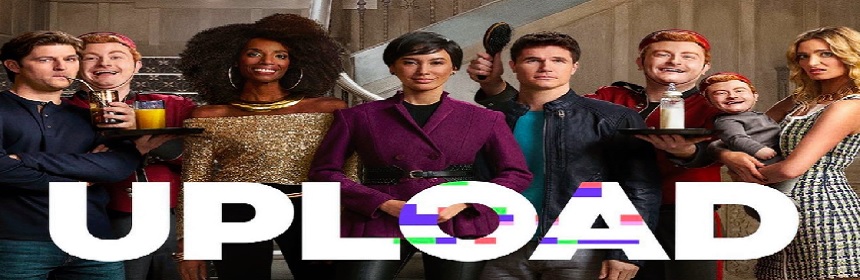
The premise of Upload is described on IMDb as follows: “a man is able to choose his own afterlife after his untimely death, by having his consciousness uploaded into a virtual world. As he gets used to his new life and befriends his angel (real world handler), questions about his death arise.”
The series kicks off with an advertisement of Lakeview by Horizen, one of the “digital Heavens” that is being broadcast on a New York subway in the year 2033, where we meet Nora, a Horizen employee who works as a handler, and we see her welcoming a new person who has been “fully rendered” into her new afterlife. We then meet Nathan, a coder, having Thanksgiving dinner with his family, girlfriend, Ingrid Kannerman, and his best friend and business partner, Jamie.
The first insight we’re given on the afterlife’s socioeconomic nature is an exchange between Ingrid and Nathan’s family, when Jamie mentions that Ingrid invited Nathan to her grandmother’s 100th birthday celebrations.
In this exchange, we discover that Lakeview is expensive, and that Ingrid’s family have been able to afford having their loved ones live their afterlives at Lakeview for what appears to be several generations, as Ingrid says “they’re a Horizen family”. Another relative of Nathan’s tells her that Lakeview is too expensive for him and that he’ll be stored on a SIM card until Nathan and Jamie get their free afterlife system, Freeyond, which they’re developing, up and running.
Nathan dies in a car accident when his self-driving car crashes into an illegally parked truck that Nathan notices but the car’s system doesn’t. As Nathan is dying, Ingrid has his consciousness uploaded to Lakeview on her account. We then see Nora welcoming him to Lakeview and from his perspective the afterlife is slowly unfolding in front of him in pixel form, and in turn the viewers see his pixelated avatar become a clear human form. Interestingly, Nora describes this process as dying and being reborn.
We see various aspects of Lakeview and its socioeconomic and digital features in the pilot, such as: Nathan trying to purchase some coffee but discovering he can’t due to the limits placed on his tab being paid by Ingrid, Nathan coming across a woman with a black-and-white avatar as a photo of her was used from 1961, ad-bots in the form of Lakeview’s concierge, and Nathan being able to talk to Ingrid on the phone. Interestingly in the next scene, we see Nora having dinner with her father, where it’s revealed he’s refusing to be uploaded as he believes her mother is waiting for him up in Heaven (the traditional one).
The next day we see Nathan grabbing a buffet breakfast only for it to disappear at 10am, much to his chagrin. Moments later another resident, Luke, appears, also disappointed he missed breakfast, which leads to him revealing a glitch – bread can appear if a machine door is closed and opened again multiple times. Interestingly, Luke reveals to Nathan that Lakeview had its own evolution over the years and there is a data torrent, a data stream between Lakeview and the real world that people have used to go back, but it destroys them.
Eventually the restrictions and eccentricities of Lakeview overwhelm Nathan to the point where he makes the decision to commit “virtucide” by going into the data torrent. Nora manages to talk him out of it by reminding him of their first interaction, and tells him it feels unnatural at Lakeview due to his consciousness actively thinking and comparing it to memories of his life, and that Lakeview’s imperfections make it just as real as life on Earth. Interestingly, Nora touches on whether God really exists. The pilot ends with Nora going home at the end of her shift, unaware that someone has remotely accessed her computer and is deleting the files of Nathan’s corrupted memories that she discovered earlier.
While the pilot emphasised a lot of Lakeview’s features to establish settings and enable world-building, the socioeconomic reality of digital afterlives is fully explored with the reveal of a “2Gigs” floor and when Nathan’s mother, Viv, goes afterlife shopping when he tells her that he wants to break up with Ingrid.
The 2Gigs floor is the lowest class of upload. They only get 2GB of data a month and once they run out, they can’t afford anything. They don’t have access to a shower or view of the lake, they are only given meals by Lean Cuisine as they sponsor the cafeteria on the floor, and they are only given free samples of books. Once their data runs out, their avatars are frozen until the data cycle resets at the end of the month. Nathan is outraged at this discovery and wants to help them, however he doesn’t really do so until the second season.
Later in the season, when Viv goes afterlife shopping for Nathan, we see that her only options are limited to a dodgy hybrid of augmented and virtual reality. However, Nathan agrees to stay at Lakeview after Ingrid pressures him when she finds out Viv is shopping around. Nathan and Nora also eventually realise that he was murdered after his wealthy neighbour, David Choak, alluded to it by pointing out that his free afterlife system threatened the digital afterlife industry.
In the penultimate episode of the season, Nathan wants to break up with Ingrid and after receiving money from Jamie as an attempt to make amends, he uses it to move to the 2Gigs floor, knowing that breaking up with Ingrid means she won’t pay for his stay at Lakeview. The season’s final moments show that Ingrid uploaded herself so she and Nathan could be together forever, much to his horror.
The second season further explores the socioeconomic aspect of Lakeview and reveals the identity of Nathan’s murderer.
In the second episode, Ingrid throws a dinner party which consists of Choak, Yang (a teenage girl living on the 2Gigs floor that Nathan befriended after his brief stay there at the end of the first season), and Luke. During the party, they discuss Freeyond, with Choak agreeing with Nathan that the poor should have the right to upload and design their own afterlives.
The following episode is dedicated entirely to exploring classism in Lakeview. The episode reveals that new windows have been installed in the 2Gigs cafeteria so the uploads can be seen drooling over the luxury dining room, so their relatives are manipulated into upgrading them. This is revealed by Yang when she sees Nathan and Luke in the dining room. Appalled, Luke tries to give her an éclair through the window only for it to disappear, this prompts Nathan to become the “Robin Hood of Lakeview” by stealing data from the rich uploads to give to the 2Gigs. Nathan starts by stealing data from Choak and giving it to Yang. The episode goes on for Nathan and Luke to up the ante in their crusade by winning money through a poker game via cheating.
Nathan’s murderer is finally revealed in the fifth episode of the season…David Choak. I was a little surprised by this reveal as he was the first to suggest to Nathan that he was murdered, no-one else did. It also begged the questions of whether Choak shot himself in the foot or whether he deliberately brought it up as a way to keep tabs on him, and whether he happened to die shortly after Nathan or uploaded himself to keep tabs on him, as he was alive when he first saw Nathan. However, in a way it also made sense due to a lack of suspects, other than Oliver Kannerman (who he was working with) and the Ludds. It’s revealed just prior to the season’s end that the murder was orchestrated to influence political elections by giving the poor the opportunity to upload, since uploads can’t vote.
The second season ends with Nathan being successfully downloaded so he, Nora and the Ludds can stop Choak’s plan, however the clock is ticking on the body he has downloaded into, and Nathan is yet to confront Choak for orchestrating his murder. Maybe this will be addressed in the show’s third season.
The next part of the Exploration of the afterlife on television analysis series will be released next week and will provide an overview of The Good Place’s moral, philosophical, and Heaven and Hell-based afterlife.
 Loveday Writing
Pingback: Behind the Reviews – Edition #33 (TV Show Analysis) | Loveday Writing